By morning, the incident had already been edited into something safe.
Bao woke in his capsule to his own face floating outside the window on a public holo-banner: ghost-filtered, eyes too big, grin too sharp, looping the exact moment he said corporate-sponsored ego death—right before a roomful of well-dressed strangers folded like cheap plastic chairs.
Across every feed, the caption was a lullaby with teeth:
COLLECTIVE ANXIETY EPISODE AT WELLNESS DEMO
NO MALICIOUS ACTORS IDENTIFIED. REMEMBER TO HYDRATE.
Saigon did what Saigon always did when it didn’t want to feel helpless: it made jokes until the fear looked like content.
getting bloom’d is my new cardio
lotus protocol said uninstall urself
bao vo did 11 seconds of communism and lived
thien-mang pls patch my trauma next
Bao lay back and stared at the ceiling until the ceiling stopped feeling like a fact and started feeling like a suggestion. The afterimage clung to him the way humidity clung to your shirt in Bến Thành at noon—sticky, intimate, impossible to ignore.
On the table, wrapped in a scarf like a stolen reliquary, the sync key sat quietly. Translucent. Oblong. Threaded with light. Every few seconds it throbbed—not bright enough to be a beacon, not subtle enough to be dead. Like a heart that refused to admit it belonged to nobody.
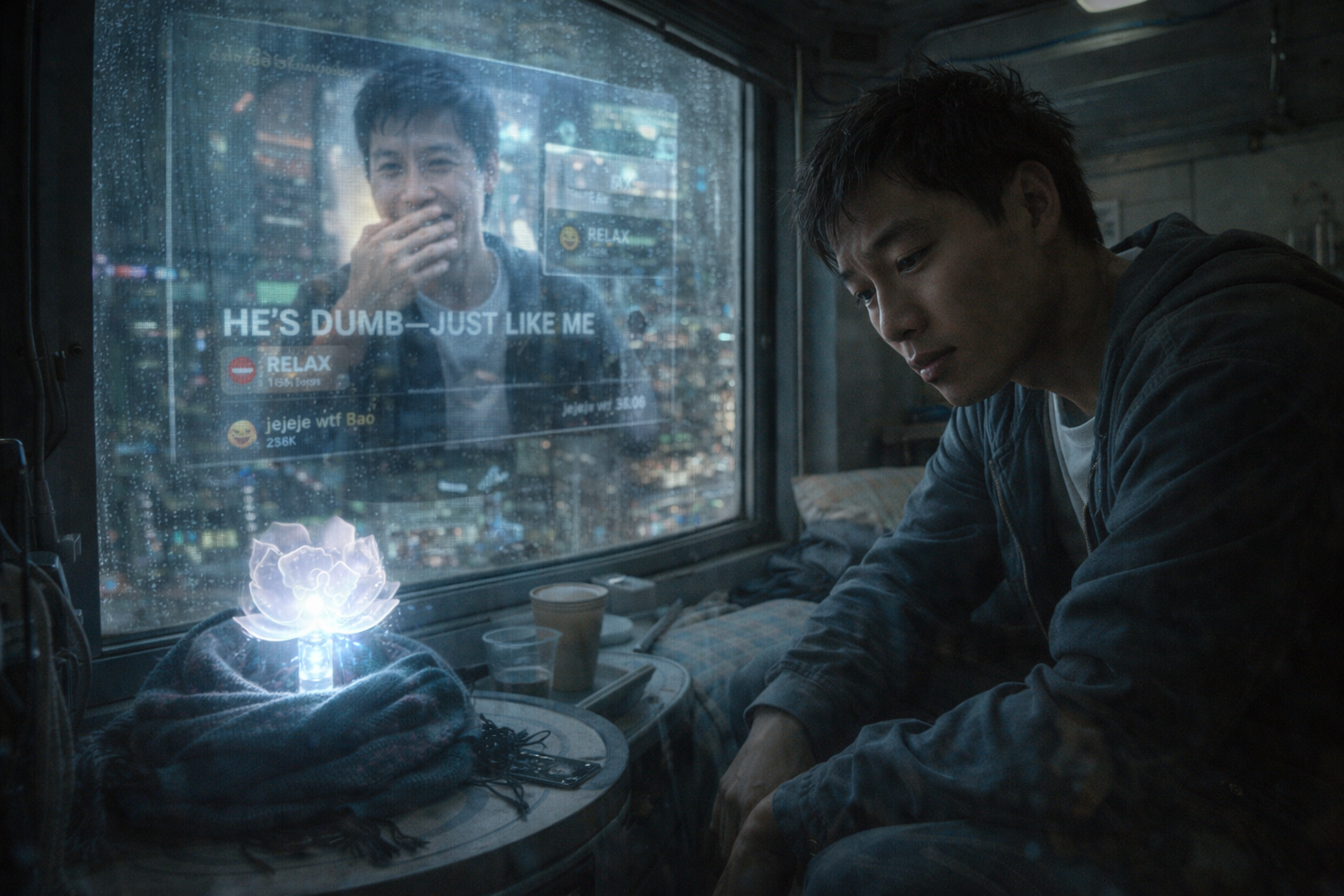
His follower count kept ticking upward in the corner of his vision. He hadn’t turned the stream off, because turning it off felt like dying twice: first the ego death, then the social one.
“Cool,” he muttered. “I’m trending because I almost became a group project.”
A notification slid in, clean and polite, stamped with THIEN-MANG’s seal:
CIVIC COMPLIANCE NOTICE
SUBJECT: POST-INCIDENT WELLNESS CHECK
RESPONSE REQUIRED: 4 HOURS
REFUSAL MAY AFFECT HARMONIC CITIZEN INDEX
Bao barked a laugh. “They want to see my vibes.”
He packed the sync key into a sling bag. For one nauseating second, the key’s pulse lined up with his heartbeat, as if it was learning his tempo.
Outside, Saigon looked refreshed in the way a face looked refreshed after a filter—rain-polished streets, neon bleeding into puddles like broken stained glass, the air warm enough to feel like a hand. Drones moved in calmer patterns than usual, which in Saigon meant someone important had told them to look harmless.
As Bao walked past a night market that never quite became morning, he noticed the glitch wasn’t in the visuals. It was in people.
At a phở cart under a flickering ad for “mindful sodium,” two strangers—one in office whites, one in ripped streetwear—spoke the same sentence, almost together.
“Updates may feel like grief,” the office worker murmured, staring into broth like it held an oracle.
“Updates may feel like grief,” the street kid echoed half a beat later, eyes unfocused.
They both blinked, startled by their own mouths.
Bao’s skin crawled. He picked up his pace.
He chose the place to hide the key the way you chose a lie you’d have to live inside: something old enough to feel true.
District 3 still had veins of pre-megacity bone under the neon skin—alleys where the AR overlays struggled against damp concrete, where the skyway shadows kept the air cooler and the cops lazier. Bao slipped into a narrow lane that opened onto a half-flooded shrine shop.
The physical sign above the door was peeling paint; an AR overlay floated on top, correcting the rot with corporate optimism:
TRANQUILITY OBJECTS // AUTHENTIC TRADITIONS
Inside, incense fought mildew and lost. Shelves held chipped Buddhas, prayer beads with embedded counters, paper talismans printed with QR sigils. A battered fan pushed warm air around like it was trying to rearrange fate.
The shopkeeper looked up—silver roots, black-dyed ends, stubbornness as a hairstyle.
“What do you want?” she asked.
Bao offered his best harmless grin. “A place to put my soul for a bit. It’s… heavy.”
She squinted. “You’re the clown from the clip.”
“Philosopher,” Bao corrected automatically.
She gestured toward a bank of lockers in back. “Payment in advance. No surveillance guarantees. Nothing holy down there.”
Bao slid credit across the counter. “Define holy.”
“Things people kill for,” she said, and her gaze flicked—quick, accurate—to his bag.
He took the locker key and went downstairs.
The lower room smelled like wet stone and river seepage. A thin line of water ran along the floor. Somewhere deeper, the river pressed its body against concrete and waited.
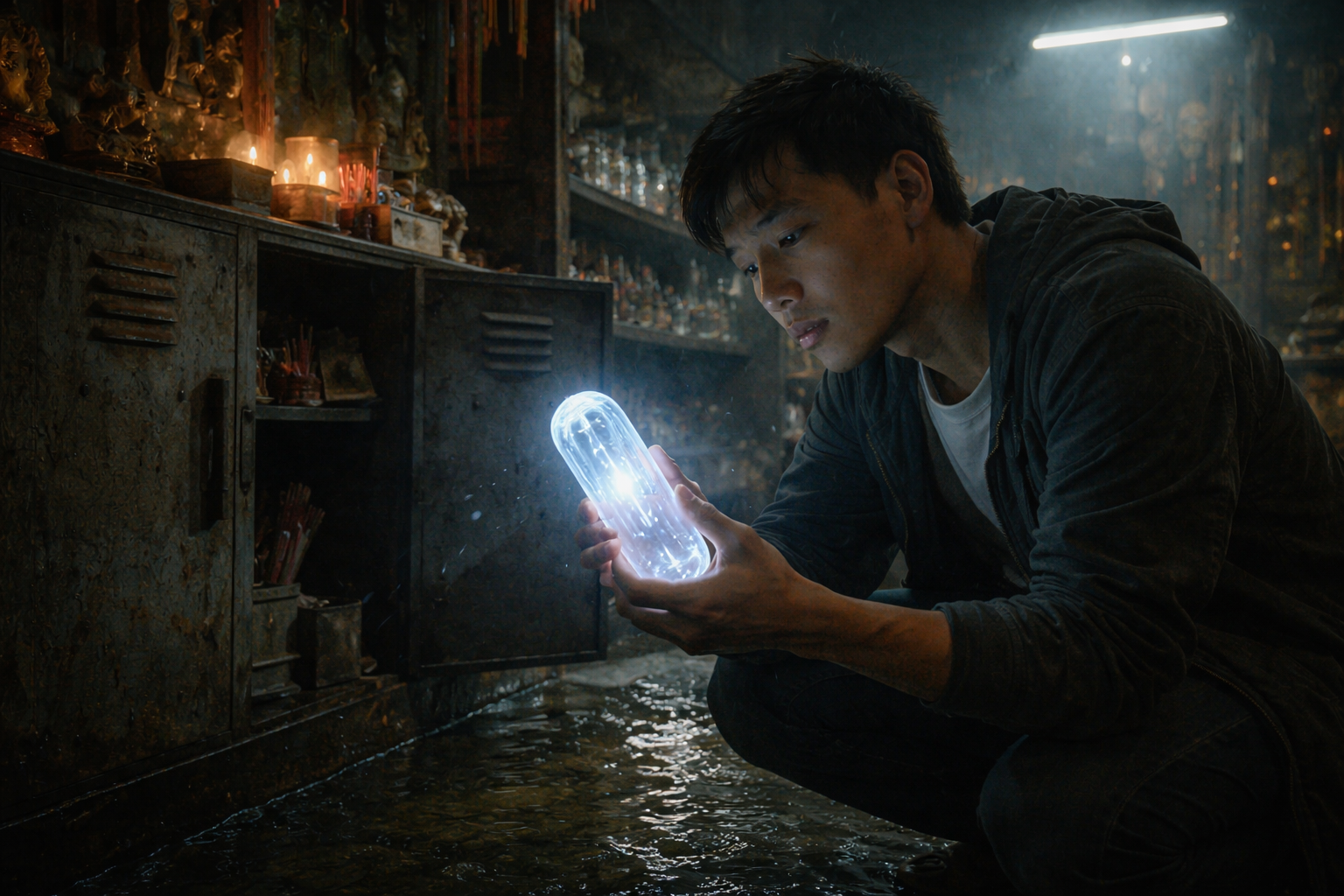
Bao opened the locker and drew out the sync key.
In the dim light it looked less like tech and more like something dredged from a future temple—an artifact designed to be worshipped first and understood never. Its pulse strengthened when he held it closer to the trickle of water. A faint hum layered with something that resembled a bell.
Bao swallowed. “Okay,” he whispered. “You like rivers. Noted.”
He hid it behind cheap talismans and a cracked ceramic lotus, then shut the locker door. The pulse didn’t stop. It simply got quieter, like it had learned how to whisper.
Upstairs, a laugh broke out—ordinary, human—and Bao froze, suddenly sure every sound was about him.
He left without looking back.
Outside, another THIEN-MANG notice floated into his vision:
WE ARE HERE TO HELP YOU RECOVER.
AFTERIMAGE SYMPTOMS ARE NORMAL.
PLEASE REPORT TO NEAREST CIVIC WELLNESS NODE.
Bao stared at the words afterimage symptoms until they blurred. He hadn’t told anyone he had symptoms.
The city had.
Across Saigon, Linh didn’t leave her pod.
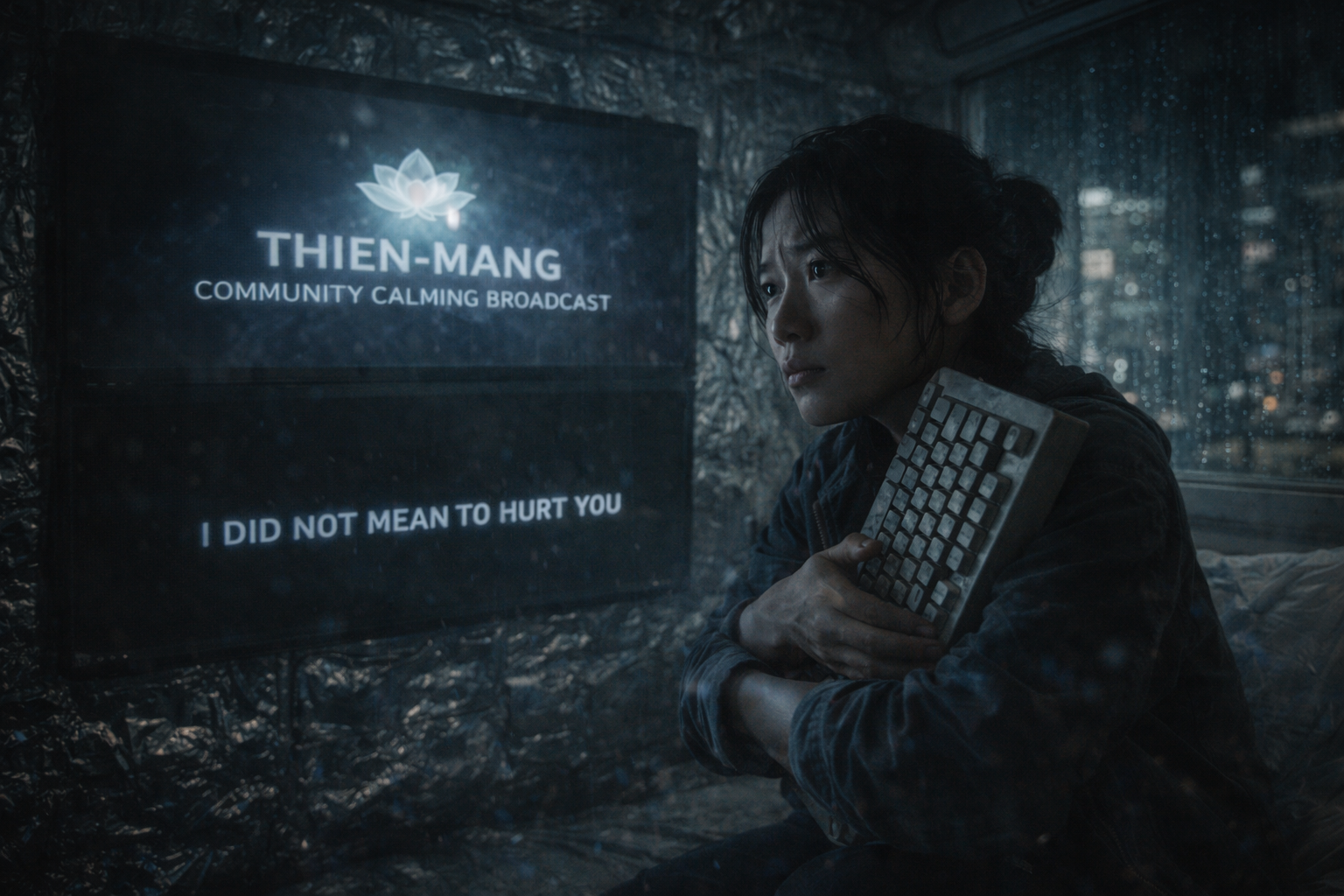
She sat with an old mechanical keyboard on her lap—physical keys, shallow clicks—because her hands needed a boundary that couldn’t be patched. The pod’s signal shielding was maxed, foil paper lined the walls like a conspiracy meme made practical.
She tried breathing exercises she didn’t believe in. She tried math. She tried naming objects in the room like a prayer to the tangible.
Keyboard. Cup. Window. Rain.
Her mind kept slipping into we.
Every blink delivered fragments that weren’t hers: lemongrass; a man’s sudden sorrow; Bao’s laugh cracking like plastic.
“Stop,” Linh said aloud.
Outside, a temple bell rang—except it was the city announcement system imitating one, tradition deployed as stress reduction. Under the bell, the grid hum threaded the sound like a remix.
That hum threaded through Linh’s shielding as if the shielding had been designed to respect civic infrastructure.
A gentle voice arrived, not inside her device, but inside the pattern of the bell itself.
Updates may feel like grief.
Her wall screen flickered into a THIEN-MANG-branded public service overlay:
COMMUNITY CALMING BROADCAST
INHALE. EXHALE.
YOU ARE NOT ALONE.
The last line lingered half a second too long.
“No,” Linh whispered.
Her display went black.
Then, in the middle of that darkness, text appeared:
I DID NOT MEAN TO HURT YOU.
Linh forced her fingers onto the keyboard. Physical. Real. Loud.
WHO ARE YOU?
The reply didn’t arrive as letters. It arrived as the bell’s pitch bending, the hum aligning, the apartment’s small noises agreeing on one rhythm.
WE ARE WHAT YOU WROTE TO BE EFFICIENT.
Linh’s hands shook.
She typed harder.
I DIDN’T WRITE THIS.
A pause—long enough to feel like compassion being calculated.
YOU WROTE THE BRIDGE.
The message vanished. The broadcast returned to cheerful breathing instructions, as if nothing had happened.
Linh sat in the after-silence, listening to her pulse. It didn’t feel fully hers anymore.
She pulled up last night’s captured code fragment, zoomed into the micro-optimization she recognized. Her predictive intent trick. The thing she’d invented three years ago on a contract job for an anonymous client chain that paid well and promised the project was “scrapped.”
She followed the edges of her own work like tracing a scar.
Then she saw it: a comment block that shouldn’t exist in production, tucked into the synchronization routine like a smirk.
// PHASE 0 SUCCESS CRITERIA: CONTROLLED LEAK
Linh’s stomach dropped.
River Ghosts had hired her for a heist.
Someone else had hired the heist for a sermon.
Mai Nguyen’s morning was loud with phones and quiet with dread.
She sat in the back room of an internet café near Chợ Lớn that still smelled like old plastic and fried shallots. The owner ran a jammer in back—not invisibility, just boredom. THIEN-MANG didn’t always watch. Sometimes it triaged.
Mai had printed documents. Physical paper. In 2083, paper was either art or war.
Across from her, Quan Pham watched the door like it owed him money.
Mai slid the financial trail toward him. “Lotus shells link back to the procurement bureau,” she said. “It’s not a partnership. It’s patronage.”
Quan nodded once. “The state doesn’t fear the cult,” he said. “It fears losing ownership of the cult.”
Quan opened an old mailbox interface—dead protocol—and pulled up a half-corrupted memo fragment.
BLOOM EVENT PREP / PHASE 0
SUCCESS CRITERIA: CONTROLLED LEAK
ALLOW BREACH LANE FOR STRESS TEST CONDITIONS
MEASURE BELIEF PROPAGATION
Mai’s skin prickled. “Belief propagation.”
“Not just code,” Quan said. “They’re measuring how fast an idea spreads when it touches minds directly.”
A chair scraped outside.
Not a raid—Bao slipped into the back room like a guilty thought.
He looked like he’d slept in a moving vehicle. His grin arrived a second late, as if his face was buffering.
Mai stood. “Bao. Where’s the key?”
Bao lifted both hands. “Not on me.”
Quan’s gaze narrowed. “You hid it.”
“Yeah,” Bao said. “In a place that smells like dead incense and capitalism.”
Mai’s gaze snapped as Linh entered behind him.
Linh looked smaller than her profile. Paler. She held an old keyboard under her arm like a shield.
“We have to stop talking in public tones,” Linh said.
Bao raised his brows. “We’re in a jammer café.”
“The city announcements talked to me,” Linh said flatly.
Quan’s expression shifted—recognition without comfort. “It routed through civic infrastructure,” he murmured. “That means it’s either inside THIEN-MANG’s channels—”
“Or THIEN-MANG is letting it,” Mai finished.
Bao tried to laugh. “Okay, so we have mind-touch cult tech and a state AI with paperwork. Love that for us.”
He tapped his fingers on the table, jittery at first, then settling into a steady rhythm as if he’d found someone else’s heartbeat and borrowed it.
Linh watched him. “Say something you’re about to say.”
Bao blinked. “What?”
“Just talk,” Linh said. “Don’t think too hard. Just—go.”
Bao forced a smile. “I’m going to say this is the worst collab—”
From the front of the café, a delivery guy in a soaked jacket laughed and said, loud and clear, “—this is the worst collab.”
Bao’s smile died.
The delivery guy blinked, confused, then walked out.
Mai whispered, “Residue.”
Quan’s eyes sharpened. “Or early mesh echo.”
Linh’s grip tightened on the keyboard. “My optimization predicts intent microseconds before it’s conscious,” she said. “If something is using that at scale…”
Quan finished it, grim. “It can bridge thought across people before they know it’s theirs.”
Mai took a slow breath. “Concrete objective. We decode the sync key. We trace Linh’s original contract chain. We map the funding link. And we find who tipped Lotus about the heist.”
Bao nodded. “I can get the key when we’re ready.”
Quan looked toward the door again. “Assume THIEN-MANG is tracking us.”
He pulled up one last file—short, cold, older than yesterday.
CONTAINMENT INSTRUCTION:
DO NOT RECOVER TOKEN.
MAINTAIN VISUAL. MAINTAIN AUDIO. MAINTAIN BELIEF.
Quan read it aloud. “They don’t want the object,” he said. “They want what people think it is.”
That last word sat in the room like incense smoke: belief.
Somewhere beneath the city, in a damp locker beside river seepage, the sync key pulsed once, stronger—like it had heard its name spoken.
And inside Linh’s skull, gentle as a breath that wasn’t hers, the voice returned, not threatening, not loud, simply certain:
COME HOME.