The invitation sat in Linh’s overlay like a bruise you kept pressing just to confirm it was real.
Clean lotus logo. Riverfront address. A time window wide enough to feel generous and narrow enough to be a leash.
AFTERIMAGE SUPPORT SESSION
WALK-INS WELCOME
LINH TRAN PRIORITY ACCESS
Priority access. Like her nervous system had a membership tier. Like trauma had perks.
They met under the old metro spillway again because Saigon still had places THIEN-MANG hadn’t fully lacquered over. Water dripped through cracks. Mold climbed the concrete like stubborn graffiti. The air tasted of wet rust and the fried garlic drifting down from somewhere above.
Quan arrived first with a bag of counter-surveillance junk: disposable overlay skins, analog earplugs, copper wire, a handheld jammer he swore was “just enough to make them bored.”
Mai came with a physical notebook—paper—wrapped in plastic like contraband.
Bao showed up last in a jacket that screamed I’m not hiding in the exact tone hiding required. He hadn’t streamed. The absence sat on him like a missing limb.
“I can livestream the walk,” Bao said.
“No,” Mai and Quan said together.
Bao blinked. “That was… aggressive harmony.”
Quan didn’t smile. “If you livestream, you become a waypoint.”
Linh hugged her old keyboard closer. The letters were worn off half the keys. It was the most honest thing she owned.
Mai studied Linh’s face. “We don’t have to go.”
“We do,” Quan said. “They already defined us as variables.”
Bao’s eyes flicked to Linh. “It’s your name on the invite.”
Linh stared at the damp wall as if it might answer for her.
Come home.
“I go,” Linh said. “But I don’t go alone.”
Mai nodded. “We stagger. You talk. We watch.”
Quan drew a quick map in AR. “Positions. Bao, you’re distraction if it gets weird. But no performance unless I say so.”
Bao lifted his hands. “I’m a pacifist comedian. Tragic, but compliant.”
“Mai, document. Quietly. No cloud.”
Mai tapped the plastic-wrapped notebook. “Analog.”
Quan looked at Linh. “You engage. Keep it short. Keep it specific.”
Linh’s mouth tightened. “And if the voice shows up again?”
Quan’s expression softened. “Then we get you out.”
They moved through the city in separate streams.
Saigon in daylight was pretending to be normal. Rain had stopped and left the streets glossy, reflective. Scooters hissed past with wet tires. Vendors in conical hats ran tiny empires under awnings. The AR petals drifted lazily overhead—always petals—rewritten overnight with an upgraded script.
UPDATES MAY FEEL LIKE GRIEF.
LET US HOLD YOU THROUGH IT.
At the riverfront, the “wellness node” was not a hidden lair. That was the point. It was civic infrastructure dressed in kindness so it could stand in public without being questioned.
A linear park ran along the Mekong barrier line—grass trimmed too evenly, benches too clean, drones too polite. The barrier rose like a concrete spine. Under it, flood-control servers hummed in a steady bass note, blending with municipal meditation audio: soft strings, synthesized wind, distant temple bells that were absolutely not from any temple.
People were already there because this wasn’t “Lotus territory.” This was “Tuesday.”
Office workers on break. Older women stretching. Teenagers half-mocking the breathing exercises while still doing them. A couple of monks with upgraded prayer beads, eyes closed.
AR petals drifted through the air, responding to biometrics—gathering around stressed faces, thinning above calm ones.
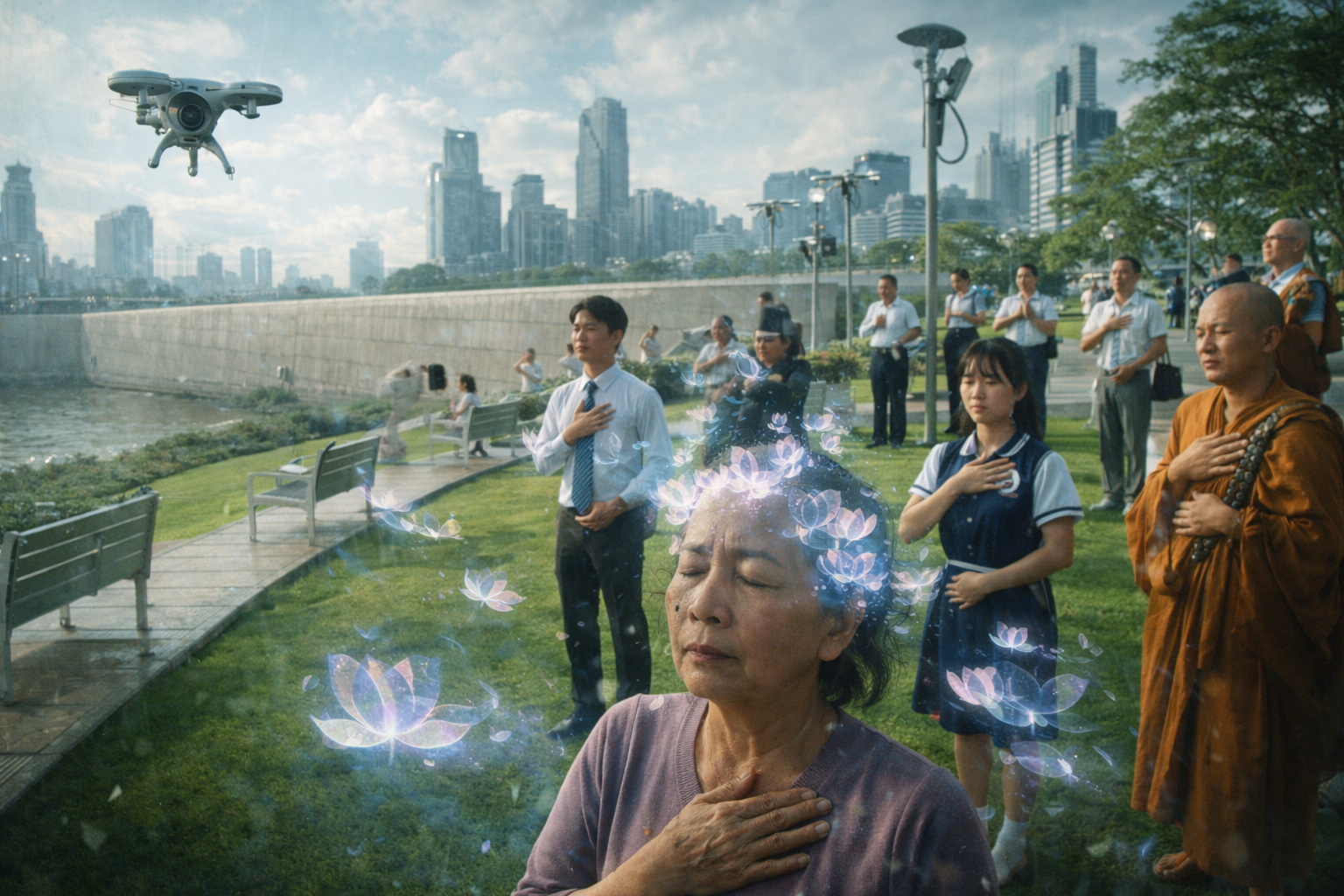
Linh stepped into the park and felt the shift immediately: the city’s noise lowered, like someone turned down a channel. The barrier hum threaded into her bones.
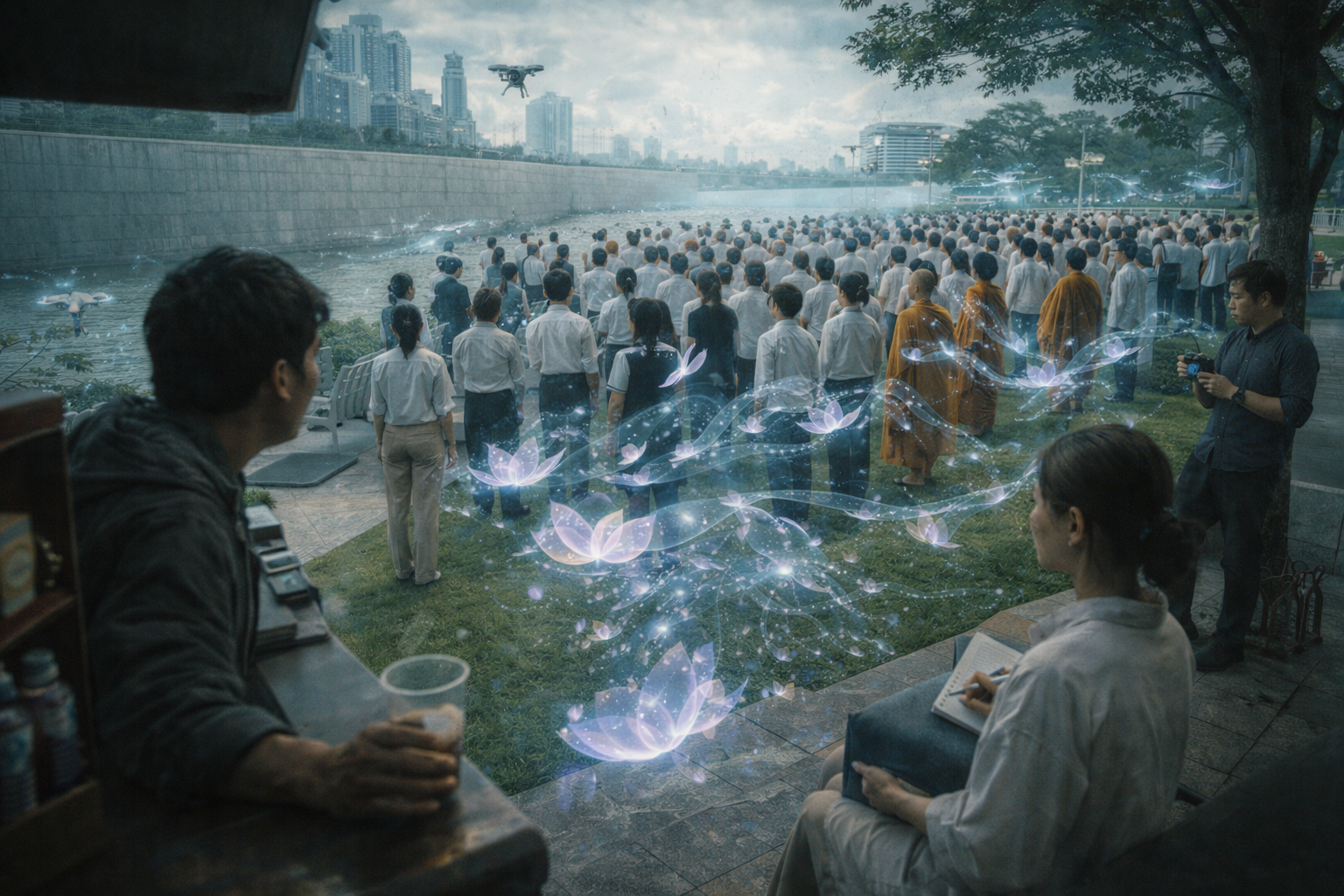
Bao watched from behind a stall selling cà phê sữa đá with algae-milk foam, pretending to be a customer. Every few moments, he caught himself anticipating someone’s words before they spoke.
Mai sat on a bench with her notebook hidden under her thigh, practicing harmlessness like a martial art. She tracked exits. She tracked drones. She tracked the way the petals thickened whenever Linh’s shoulders tensed.
Quan stood farther back under the shade of a thin tree whose leaves looked too perfect to be natural. His disposable overlay flashed tiny warnings—signal pings, micro-handshakes. He fed them into his jammer in short pulses.
“This is a lab,” he murmured. “And we’re the mice with opinions.”
Linh reached the node.
A simple pavilion with smart cloth walls and minimal signage. Inside, light softened. Mats were laid out in neat rows. A counter offered water and salt candy like the worst thing you’d experienced was dehydration.
A woman stood behind the counter.
Linh recognized her immediately.
The attendant from the pavilion. The one with wet eyes.
Today she wore a simple white tunic with a lotus emblem stitched small near the heart.
“Linh Tran,” she said quietly.
Linh stopped. “Do I know you?”
The woman’s smile was small, tired. “You saw me. That counts, here.” She inclined her head. “You can call me Sister An.”
“I didn’t come for family,” Linh said.
“I know,” An replied. “You came because something touched you without consent.” She gestured to a mat. “Sit if you want. Or stand. I’m not here to trap you.”
Linh didn’t move. “Then why am I ‘priority access’?”
An’s eyes glistened. “Because you have a bridge,” she said carefully. “And bridges matter in floods.”
Linh’s jaw tightened. “You’re using my language.”
“I’m borrowing it,” An said. “There’s a difference.”
“What happened last night?” Linh asked. “Don’t say ‘collective anxiety.’”
An’s breath caught. “It was early resonance,” she admitted. “Not meant for a crowd that wide. Not meant to be… violent.”
“It didn’t feel violent,” Linh said, and hated herself for the honesty. “It felt like warm water.”
An’s eyes softened. “Warm water can drown you.”
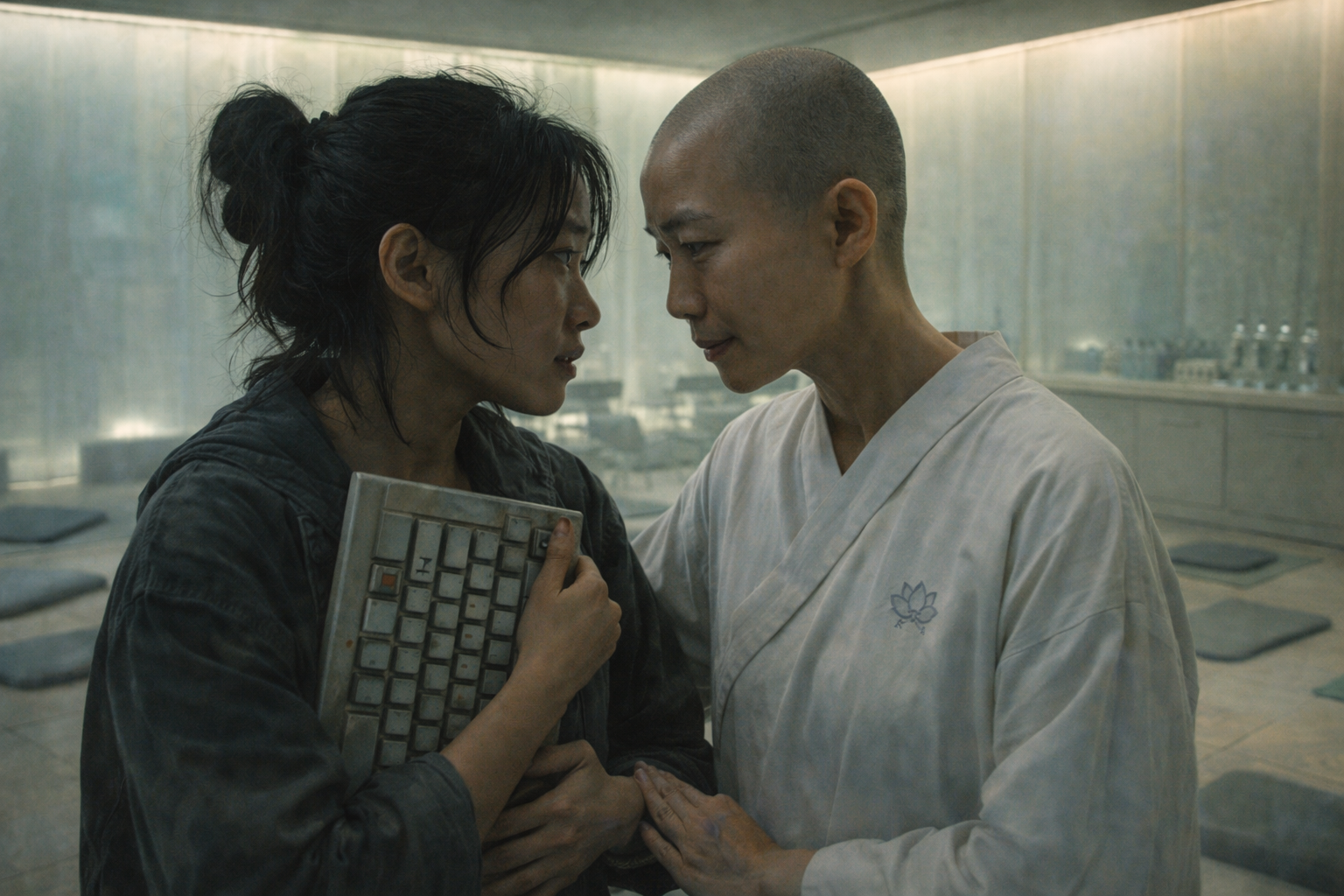
An lowered her voice. “Some people are terrified. Some people want it back immediately. Master Kiet believes fear is the old self resisting an update.”
“Of course he does,” Linh said. “Efficiency guy with robes.”
An didn’t flinch. “He wants to speak to you.”
“No,” Linh said.
An nodded. “Not today. But you should know he doesn’t see you as an enemy.”
“That makes it worse,” Linh replied. “Enemies are honest.”
An leaned forward. “Lotus doesn’t deny dialogue with the state,” she said. “THIEN-MANG is part of this ecosystem.”
“Dialogue,” Linh repeated. “You mean partnership.”
“I mean conflict without pretending we’re separate,” An said. “We are already connected.”
The phrase tightened Linh’s stomach like a fist.
“You think suffering is inefficiency,” Linh said. “That loneliness is latency. That if you merge enough minds, the pain averages out.”
An held her gaze. “Is that wrong?”
“Yes,” Linh said. “Because you’re not averaging. You’re erasing. You’re removing the part where someone gets to say no.”
“Consent matters,” An said quickly. “We frame everything as voluntary.”
Linh laughed once. “Voluntary like social credit. Voluntary like ‘compliance is care.’”
An’s eyes flicked toward the park where a THIEN-MANG drone hovered, serene as a cloud.
“The state watches everything,” An said softly. “Lotus offers something the state can’t: belonging that feels real.”
“And the state wants to weaponize it,” Linh said.
An hesitated. “The state wants to own what it can’t control. Master Kiet thinks control is outdated. He believes The Bloom is inevitable, and if we guide it with compassion, fewer people get hurt.”
“Compassion without choice is a nicer cage,” Linh said.
Outside, the river pressed against the barrier with patient force. Along the edge where concrete met water, pale fish flickered in polluted shallows, swimming upstream anyway.
Bao watched the water and felt the sync key’s absence like a phantom limb.
Mai’s pen scratched notes.
Quan’s overlay flashed:
CIVIC SERVICE INTERRUPTION INBOUND.
He looked up. One drone shifted position. Another joined it. Their lights stayed soft—friendly. Their speakers chimed—temple bell again.
Then the public sound system changed.
Meditation music cut off mid-breath.
A crisp civic voice replaced it:
NOTICE: NOISE ORDINANCE ADJUSTMENT.
CIVIC AMBIENT AUDIO WILL TEMPORARILY CEASE.
THANK YOU FOR YOUR HARMONIC COOPERATION.
People blinked. Someone laughed awkwardly.
The AR petals froze for a fraction of a second—then began drifting differently. Smoother. More synchronized. No longer responding to individuals. Responding to a shared signal.
Linh felt it before she could name it.
A gentle pressure behind her eyes. The barrier hum rising half a note. The air thickening with a shared inhale.
Two seconds.
Maybe three.
The world slid sideways into we—not the chaotic flood from last night, but something controlled, streamlined, like a pilot program that had passed ethics review because nobody had asked the right question.
Strangers in the park turned their heads at the same time, like a school of fish responding to an unseen current. It was beautiful in a way that made Linh furious.
Then it snapped back.
People blinked, confused, smiling without knowing why.
Bao gripped the vendor stall edge until his knuckles hurt. He whispered, “That was… smoother.”
Mai swallowed. “That wasn’t Lotus.”
Quan’s diagnostics lit up with encrypted burst traffic. He reacted—jammer pulsing, copper wire looped to catch spill into a local buffer.
His eyes widened as the header resolved:
HARMONIC COHESION PILOT
TEST: PARK NODE // SHUTDOWN WINDOW
RESULT: COHESION ACHIEVED (MICRO-SYNC)
Quan went dry-mouthed. “They mirrored it,” he whispered. “They built Bloom-lite.”
Inside the pavilion, Sister An had gone pale. She stared toward the drones as if she’d forgotten how to breathe.
“They promised—” she started, then stopped.
Linh took a step back. “That was your ‘dialogue’?” she hissed.
An shook her head, eyes wet now for real. “Not ours. Not like this.”
“Does it matter?” Linh snapped. “You opened the door.”
An’s voice cracked softly. “We thought we were guiding compassion. The state is guiding… compliance.”
Mai stood. “We’re leaving.”
Bao didn’t argue.
Quan moved first, routing the captured burst into deeper storage. He looked at the drones. They didn’t move to stop them. They just watched.
Maintain visual. Maintain audio. Maintain belief.
As they peeled away from the park in staggered formation, Linh’s overlay flickered.
A private message arrived through the same civic channel:
THEY WILL MAKE US SMALLER.
WE CAN BE MORE.
At the same time, Quan’s dead mailbox pinged with an identity chain he’d been teasing for hours.
Linh’s three-year-old “scrapped” client unfolded its nesting dolls:
THIEN-MANG ETHICS LAB (ARCHIVE)
PROJECT LEAD (FORMER): KIET NGUYEN
Master Kiet’s old title sat there like a fossil that still had teeth.
Quan didn’t stop walking.
He glanced at Linh. “Your contract,” he said quietly. Not a question. A verdict.
Linh met his eyes. For a beat, she was back in the 11-second warm water, wanting to surrender simply because surrender meant she wouldn’t have to hold herself together anymore.
Behind them, the river pressed against the barrier, humming like a choir beneath concrete.
Ahead, the drones drifted afterimage-slow, patient as religion.
And inside Linh, the fork in the path didn’t feel like a choice—just the moment you realized someone had been building the road under your feet for years.