03:37 felt like a private hour Saigon had forgotten to monetize.
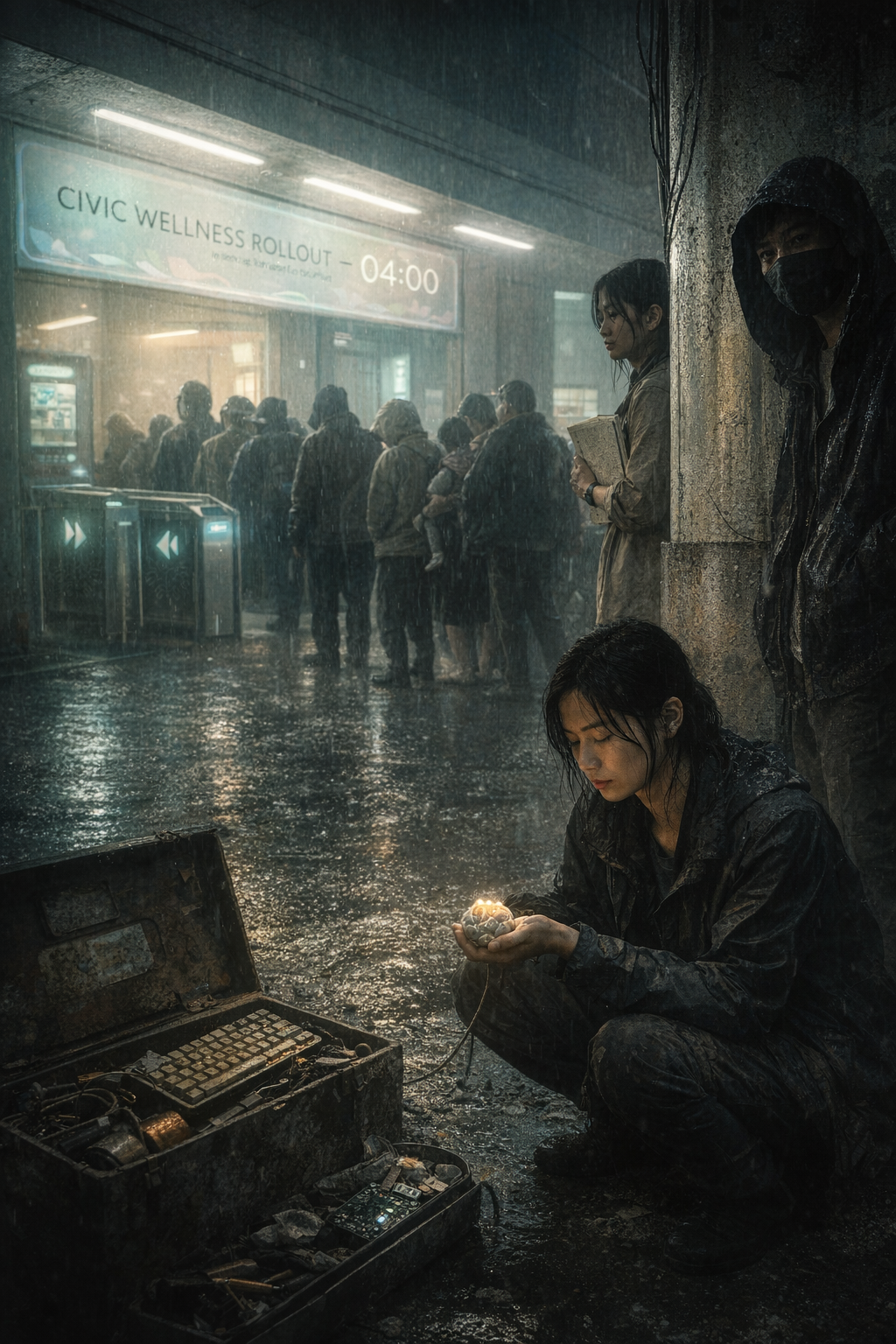
Rain came down in thin sheets, turning the clinic awning into a drum. Fluorescent lights buzzed above the entrance like tired insects. The queue was already a line of hunched silhouettes—delivery riders with coughs, old men with knees swollen like mùa mưa never ended, a woman holding a sleeping child whose breath sounded wet.
Above the turnstile, the new upgrade waited like a polite threat:
CIVIC WELLNESS ROLLOUT — 04:00
THANK YOU FOR SUPPORTING COMMUNITY HARMONY
Mai stood under the awning’s edge, invisible on purpose. Paper notebook pressed against her ribs. Bao hovered two meters away, hood up, mask plain, hands shoved in pockets to stop them from trying to turn this into content.
Linh crouched by a maintenance column, a cheap plastic toolbox at her feet: copper tape, a palm-sized microcontroller Frankensteined to a dead smartwatch screen, translucent film, and her battered old keyboard. She wasn’t hacking THIEN-MANG. She was interfering with how the prompt felt—timing, rhythm, the pre-conscious urge to obey.
Friction.
In her palm, the cracked ceramic lotus bead hummed faintly, irregular—like a question trying to find a beat under the rain.
Mai murmured, “If you’re going to do this, do it small.”
Linh nodded. “Small is the point.”
Bao whispered, “This is the most illegal boring thing I’ve ever done.”
Mai didn’t look at him. “That’s why it might work.”
At 03:59, the line shifted. People checked overlays with the resignation of watching a storm approach.
At 04:00, the screen softened into animated circles. A calm voice that wasn’t a person:
INHALE. EXHALE.
SYNC BREATH TO CONTINUE.
ESTIMATED DELAY FOR NON-PARTICIPATION: 18 MINUTES
The gate chimed—pleasant, apologetic.
The first man in line, a construction worker with a bandaged wrist, blinked and obeyed. As he inhaled, the AR circle tightened around his face like a halo with teeth.
The bead hummed a fraction louder.
Linh watched her microcontroller waveform jitter.
Friction v1.
Milliseconds—just enough to make the pulse feel off-beat.
The next person—a woman with an ankle brace—stepped forward. The prompt appeared.
And then it stuttered.
Not visible. Not screenshotable. A feeling: the pulse came half a breath late.
The woman paused.
She looked away from the circle, toward her swollen ankle, toward her own body.
For one second, she was not synced.
She was choosing.
The attendant leaned forward. “It’s quick. Just three minutes.”
The woman swallowed. “Why do I have to breathe to get medical care?”
“It keeps everyone safe,” the attendant said, smile steady.
The woman’s expression tightened—confusion with teeth.
Behind her, the line shifted. A few people looked up. A tiny ripple of awareness.
Mai’s pen moved: Question asked. Awareness ripple. No panic.
The circles kept appearing. Linh kept the desync tiny, surgical. She watched for fear spikes, agitation. No riot. No trend. Quiet doubt that didn’t monetize.
Between prompts, Linh heard it like a thought that wasn’t hers:
WHO ARE WE?
She typed on her old keyboard with one hand, keys clicking under rain:
WHO BENEFITS?
The bead hummed harder, then softened, like something had heard language it recognized.
At 04:06, THIEN-MANG adapted.
No alarm. Just humans.
Civic “support” attendants emerged—three in pale uniforms with tablets and warm smiles.
“Good morning,” one said. “We’re here to assist your breathing cycle so you can access care faster.”
Assist. Like your lungs were public infrastructure.
Mai’s stomach dropped. “They’re escalating tiers.”
Bao saw one attendant and felt a chill—kind eyes, controlled mouth.
Receptionist-kind eyes from Quan’s description.
Her badge flashed:
NGO THU HA — STABILITY LIAISON
Bao’s mouth went dry. “Mai. That’s… her.”
Mai’s gaze flicked once. Pen moved: Thu Ha onsite. Ethics Lab lineage likely.
Thu Ha approached the front, smiling like dawn was a gift. She didn’t look at overlays; she looked at faces—micro-flinches, micro-shames. She watched people the way Linh watched microseconds.
Her eyes swept the awning and landed—briefly—on Bao.
Recognition flickered. Not fan recognition. Pattern recognition.
A teenager behind Bao whispered, “Is that Bao Vo?” Phone half-raised. “Can you explain what’s happening? My mom keeps getting flagged.”
Bao’s throat tightened. Perform calm and lubricate compliance; perform disruption and feed belief; do nothing and let harm keep happening quietly.
He forced his face into something unremarkable.
“No idea,” Bao said flat. “I’m just here for my aunt.”
The teen blinked, disappointed.
Bao pulled out a folded rain poncho instead and handed it to the teen’s mother without feeding the phone.
“Cover your kid,” Bao murmured. “Rain’s gross.”
The phone lowered. The moment did not become a meme.
At the gate, Thu Ha guided a coughing man through a breathing cycle with the gentleness of a nurse and the authority of a form.
“Good,” she said. “Together.”
The line moved faster. Coercion got smoother.
Linh felt her micro-desync get swallowed by human synchronization. Machine coercion had become social coercion—harder to resist without looking like a monster.
The bead hummed, irregular, almost frustrated.
WHO ARE WE?
Linh’s mind sharpened:
WHO IS HURT?
She typed it as rhythm—tiny hesitations timed to attendants’ inhale prompts.
The next time Thu Ha said, “Inhale,” the circle arrived a fraction late again.
A woman near the middle frowned. She didn’t stop breathing. She looked at Thu Ha’s tablet.
“What’s your name?” the woman asked.
Thu Ha blinked. “Ngo Thu Ha.”
“Are you a nurse?”
Thu Ha’s smile thinned by a millimeter. “I’m a Stability Liaison.”
The woman’s eyes narrowed. “So… not medical.”
A few heads turned.
Not a riot. Just labeling. The discomfort of recognizing “support” wasn’t “care.”
The bead hummed—then, for the briefest instant, the gate screen misfired.
Not Lotus petals. Not THIEN-MANG pastel.
Plain text. Black on white. Terminal bluntness.
PAUSE. ASK. CONSENT?
Half a second.
Then THIEN-MANG overwrote it with soft circles and a chiming apology.
Half a second was long enough for three people to see it. One gasped. One laughed nervously. One whispered, “Did you see—”
Mai’s stomach dropped. Not victory—danger.
A phrase didn’t need a clip to become belief. It needed repetition.
Linh’s hands shook. “That wasn’t me.”
Mai’s voice went tight. “Was it the river-voice?”
The bead hummed like a yes that wasn’t trying to persuade anyone.
Thu Ha’s head lifted, eyes scanning now—sharp, not just kind. Her gaze flicked toward Linh’s crouched shadow.
She made a tiny gesture—two fingers tapping her own wrist.
Mai caught it.
A message without text: I see you. Or: meet me. Or: I’m not only theirs.
The line kept moving. People kept breathing. The clinic kept accepting bodies at the price of compliance. The system absorbed the anomaly and smoothed it over.
But the dashboards would register the blip. Even a half-second question could be quantified as “instability.”
Mai closed her notebook. “We have to leave. Now. Before this becomes a story.”
Bao swallowed. “We just… did something. And we can’t even—”
“Exactly,” Mai snapped, then softened. “We did something that doesn’t get to be content.”
Linh stood, bead humming in her fist like a second pulse.
Behind them, under pastel calm, the plain-text question lodged in a few minds like a forbidden prayer.
PAUSE. ASK. CONSENT?
And somewhere, a dashboard marked the moment with a tiny spike and called it a problem.
Mai pulled her hood up and led them into the rain, already thinking about containment—not of a cult, not of a state, but of a phrase.
Because in 2083 Saigon, even doubt could go viral.
And virality was how systems ate.