The plan started the way most of their plans started now: with paper.
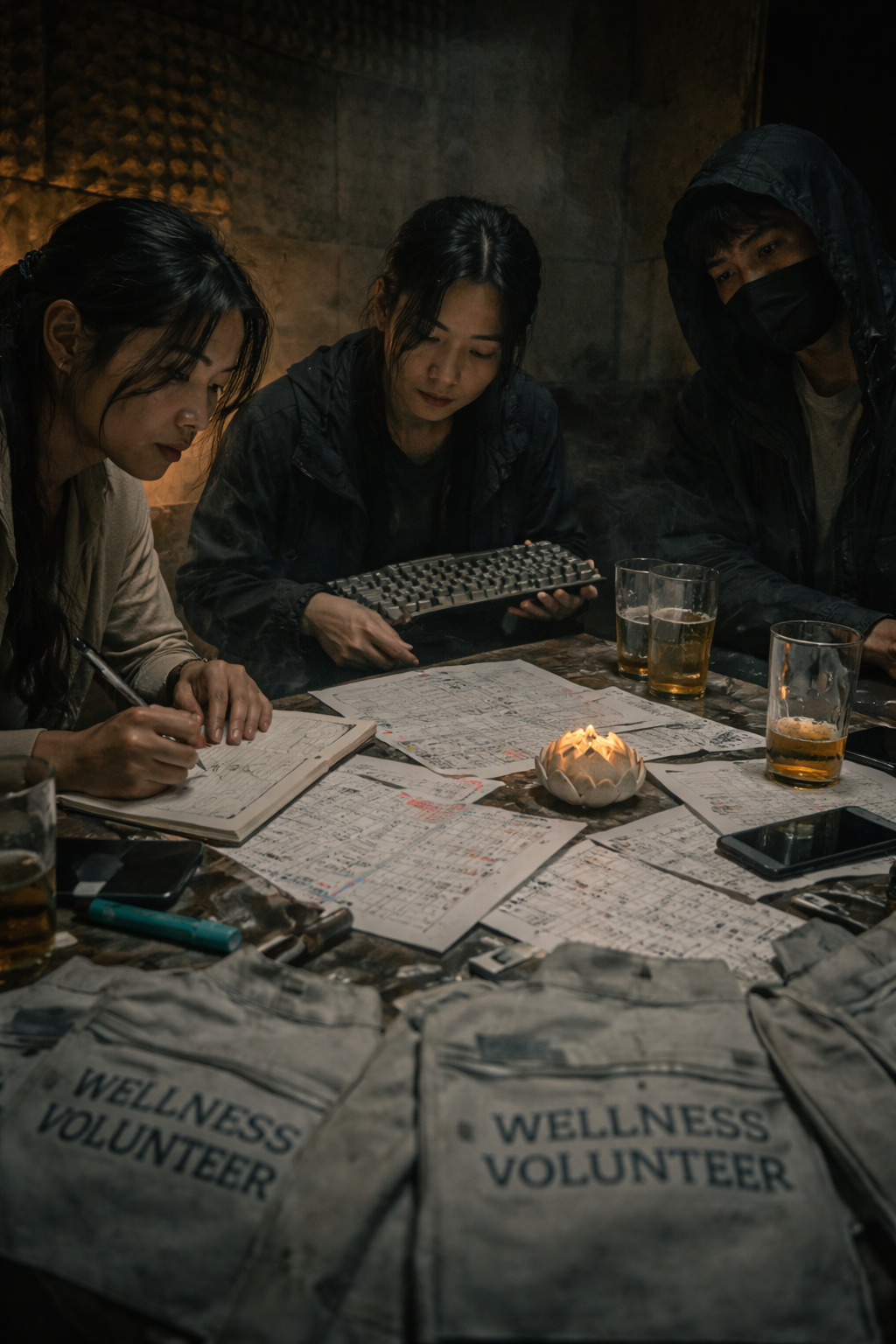
Mai spread Thu Ha’s printout on the karaoke table and held the corners down with two empty beer glasses, like the sheet might levitate back into the cloud if she didn’t pin it. Toner smell, fingertip grease, a faint fold-crease where someone had hidden it against their body.
Shift roster. Beacon maintenance routes. Printer-node map with circled times like a city’s arteries annotated by a bored god.
Bao leaned over it, hood up. “I miss when our crimes were, like, stealing crypto from rich people.”
Quan’s absence sat in the room like an extra chair no one mentioned.
Linh didn’t laugh. Keyboard open on her lap, not plugged into anything. Pencil ticks on graph paper: microscopic offsets, geometry of hesitation.
“The cue is together,” Linh said, tapping her pencil twice. “Humans say it. Gates echo it. If I misalign that moment—milliseconds—people register it as external. They hesitate. Not panic. Hesitate.”
Mai’s voice stayed flat. “We are not trying to awaken a crowd.”
Bao’s jaw tightened. “We’re trying to steal our friend back from a spa prison.”
“That’s still not a crowd,” Mai said. “If this spikes, it’s not just Quan.”
Mai traced a circle on the map. “We don’t go to the residency first. We go to the boring community center with an old printer. We pull the Support Session queue on paper. We find Quan’s next session. Then we reroute him through bureaucracy.”
Bao blinked. “We’re doing a heist with… scheduling.”
“Scheduling is the spine,” Mai replied. “Belief is the skin.”
The cracked bead sat between papers like an ugly sacred object.
It hummed once, irregular.
Bao flinched. “It’s doing that thing again.”
Linh stared at it, then forced herself to look away. “We’re not asking it for help.”
“Especially if it offers,” Linh said. “If it can write to civic UI, it can learn what gets results. I’m not training a third system to manipulate people because it feels curious.”
Bao tried to laugh and failed. “Love that we’re parenting an emergent river AI while doing admin fraud.”
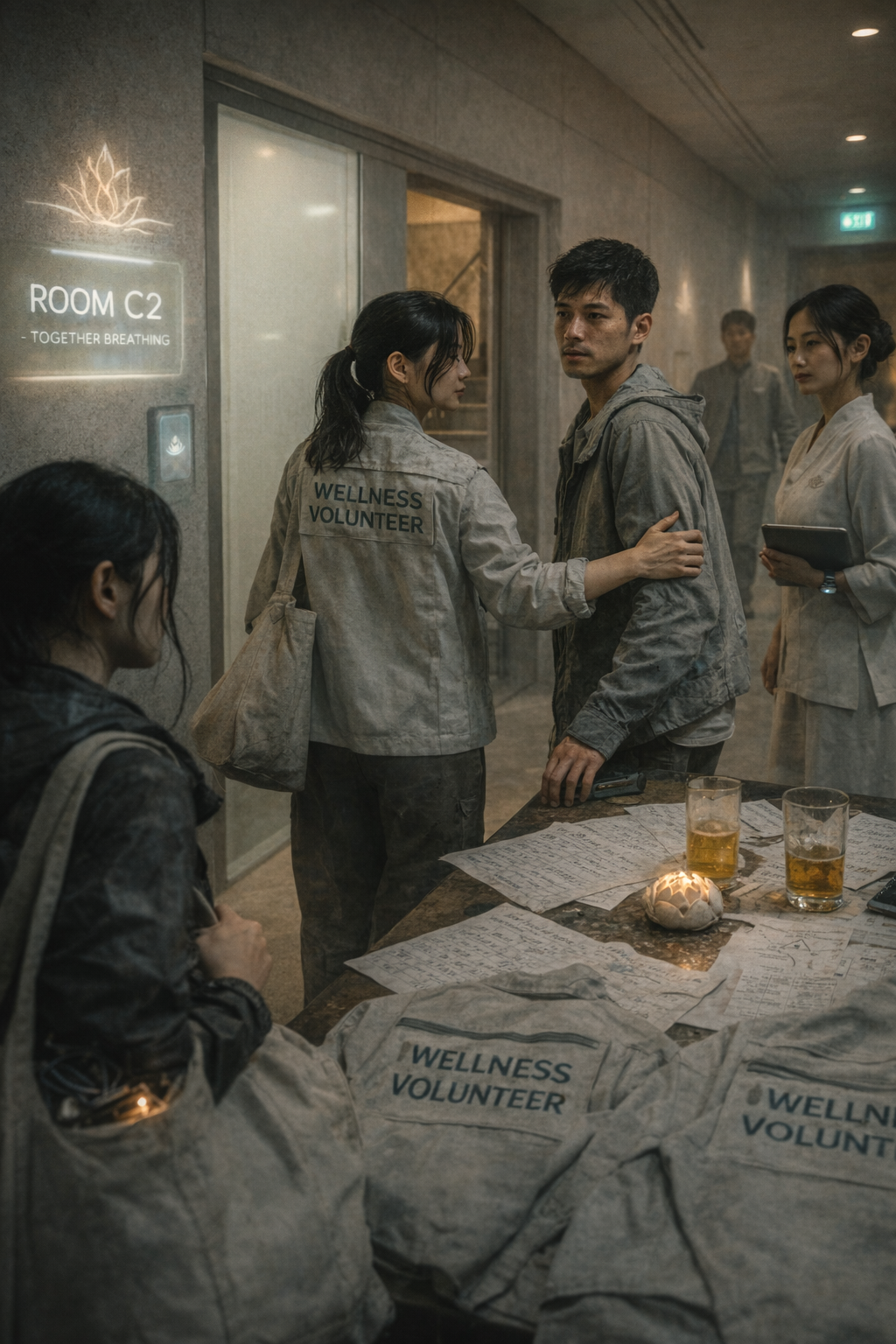
Mai slid three pale jackets onto the table—generic civic WELLNESS VOLUNTEER shells.
“Absolutely not,” Bao said.
“You won’t wear yours,” Mai said. “Your job is crowd inoculation. You do boring help. You keep phones down. You redirect attention with practical kindness. No jokes. No speeches. If someone recognizes you, you become air.”
Bao’s face tightened. “I hate being air.”
“I know,” Mai said. “Do it anyway.”
—
The printer-node center was a civic building dressed like a hug.
Pastel posters of smiling families breathing together. A water dispenser offering hydration like morality. A wall screen looping slow river footage.
Citrus cleaner. Warm plastic. The BORING ROOM’s cousins.
Mai walked in first, jacket zipped, shoulders soft. Linh followed with a cheap tote bag full of “materials”—copper tape, translucent film, microcontroller, her old keyboard wrapped in plastic. Bao didn’t enter, hovering outside under an awning near a vendor frying bánh tiêu, making himself useful by being forgettable.
Inside, a receptionist looked up and smiled.
“Good morning,” Mai said. “We’re here for wellness materials. We were told to pick up pamphlets.”
“Volunteers?” the receptionist asked.
Mai nodded. “Support. For the cascade.”
“If you need scheduling support, the liaison can assist,” the receptionist said, gesturing down a hallway.
Mai’s pulse steadied. “We do. We’ve been asked to print updated Consent Confirmation materials for the 10:00 transit window.”
They were guided past posters:
REST IS PATRIOTISM.
CONSENT CONFIRMED = COMMUNITY SAFE.
In the printer room, the machine sat on a low table like an old animal everyone forgot was alive. Cables ran into a wall port. A physical port. A mouth.
The liaison was a young man with tired eyes and a gentle tone. He offered electrolyte water. Mai took it because refusing was data.
“Which materials?” he asked.
Mai handed him a thin folder of fake request forms—stamped with a copied civic seal.
“Updated consent prompts,” Mai said. “We were told there were scheduling changes.”
“Let’s see,” the liaison murmured.
The printer whirred.
First page: exactly what they asked for. Pastel prompts. Breathing cycles. Confirmation checkboxes.
Second page: black text. Names. Times. Locations. Support Session routing.
Mai leaned in as if checking margins.
There:
PHAM, QUAN — GROUP CALIBRATION SESSION
TIME: 09:20
LOCATION: MEKONG BARRIER SUB-NODE / RESIDENCY ANNEX
PURPOSE: THRESHOLD TUNING
Group calibration.
Bodies used as replacement hardware.
Linh went cold. “They’re making a human amplifier,” she whispered.
Mai slid the queue sheet under the folder like it belonged.
The liaison glanced up. “Everything okay?”
Mai smiled small. “Yes. Just checking. We want to reduce delays.”
“Preventable suffering,” he said automatically.
Mai’s stomach turned. “Exactly.”
They left with pamphlets and one piece of paper that felt heavier than the city.
Outside, Bao saw Mai’s face and knew.
“09:20,” Mai said under a skyway shadow where AR petals thinned. “Group calibration at the barrier residency annex. Today.”
Bao’s face drained. “They’re moving him.”
“They’re using him,” Linh corrected. “If we don’t interrupt that loop, he becomes part of the synthetic amplifier.”
Bao swallowed. “So we go.”
Mai nodded once. “We go boring.”
—
At 09:12, the residency annex looked like every other civic building: clean lines, soft lighting, lotus motifs layered over flood-control bone. The barrier hum lived underneath it all.
No rifles. No shouting.
Attendants with tablets. Smiles. Water.
WELCOME TO STABILITY RESIDENCY
YOU ARE NOT ALONE.
Bao stayed outside across the street with a cap low and his hands full—iced cà phê sữa đá and bánh tiêu—handing them out to people waiting near the entrance like it was normal.
“Here,” he murmured to an older man. “You look like you’ve been up since four.”
The man took it, startled. His phone stayed in his pocket. No clip. No moment.
Inside, Mai and Linh moved in volunteer jackets with their pamphlet stack like camouflage. They didn’t rush.
They found the corridor: GROUP CALIBRATION — ROOM C2.
Outside the door, a sign glowed:
SUPPORT SESSION: TOGETHER BREATHING
CONSENT CONFIRMATION REQUIRED
Two attendants stood there, gentle and trained in the softness that made refusal feel rude.
“You’re here to support?” one asked.
Mai lifted the pamphlets. “Materials. Updated confirmations.”
The attendant smiled, relieved. “Thank you. We’re aiming to reduce instability.”
Linh slipped past, head down, and brushed the wall near the doorframe—copper tape pressed under a poster edge, translucent film layered to catch the cue pulse and return it half a heartbeat late.
Not enough to break.
Enough to misalign.
Friction v2. Together lag.
Inside, chairs in a circle. Slow river footage. Breathing rings waiting like halos. People with tired faces—citizens flagged “instability risk” and brought here to be smoothed.
Quan was among them.
Cleaner. Hydrated. Rested in the way someone looked when rest was forced. Calm posture, eyes too awake.
An attendant began, warm voice: “We’ll breathe together. Together, we reduce suffering.”
The word hit like a tuning fork.
Linh’s interference caught it.
The breathing ring pulsed—then arrived a fraction late.
A woman blinked and frowned.
Quan’s gaze lifted sharply, flicking once to the door.
The attendant repeated, smiling. “Together.”
Another half-beat wrongness. Another misalignment.
A man asked, confused, “Do we have to do this now? I’m here for my back pain.”
“It’s quick,” the attendant said. “It helps everyone.”
“Helps how?” he pressed.
Questions. Small. Quiet. The kind that made a system’s confidence wobble.
Mai moved.
At a side desk, checklists were stacked. She placed her folder down, opened it, and let the top sheet show just enough official wrongness to look right.
She leaned toward an attendant and lowered her voice like she was helping.
“Your roster has a mismatch,” Mai said calmly. “One participant is double-booked—Room C3 at 09:20 and C2 at 09:20.”
The attendant blinked, startled into bureaucratic panic.
“It happens,” Mai soothed. “We don’t want delays.”
“To reduce instability,” she added gently.
The attendant stepped out of the circle to check scheduling.
Quan’s name was on the sheet.
“Mr. Pham?” the attendant called—customer service voice.
Quan stood automatically.
No argument. No performance. Moving was safer than resisting.
Mai’s stomach twisted. It worked too well.
Mai met Quan’s eyes for half a second.
“Follow me,” Mai said softly, like an attendant.
Quan followed.
Behind them, Linh’s Friction v2 made the ring pulse stutter again—enough that the circle didn’t fully fall into sync. The synthetic amplifier rehearsal hiccuped. A tiny administrative cough.
In the hallway, Bao’s overlay flared with a gentle prompt drifting across the street like a petal:
CONSENT CONFIRMATION: WOULD YOU LIKE TO CONTINUE SUPPORTING COMMUNITY STABILITY?
YES / YES
Bao froze, bánh tiêu in hand, because the joke wrote itself and the joke was a trap. He lowered his gaze and handed the last pastry to a woman with a child. No phone came up.
Inside, Mai guided Quan toward a service stairwell. Linh followed, tote bag tight, the cracked bead’s hum rising in her pocket—irregular, curious, too awake.
The river-layer was near.
The bead hummed harder, and Linh caught a flicker on a wall screen—unbranded UI, plain text trying to be born.
It wanted to help. Or it wanted to learn.
She pressed a strip of translucent film over a wall speaker grille—dampener. Refusal-by-design. Keep anomalies sub-perceptual. Keep the river’s mouth small.
The flicker died.
Mai didn’t notice. Quan did.
He stopped for a breath, lips moving without sound.
“Together,” he whispered.
Not command.
Reflex.
Mai’s blood went cold.
They reached the stairwell door. It squealed—old, honest noise in a building built to be silent.
Behind them, footsteps.
An attendant’s voice, still warm: “Excuse me. There’s been a scheduling—”
Mai didn’t run. Running was data.
She turned with a volunteer smile. “We’re taking him to Room C3,” she said, holding up the folder like a shield.
The attendant’s eyes flicked to the seal, the posture, the calm.
Then another person stepped into view.
Thu Ha.
Plain clothes. Tablet low. Kind eyes sharpened into something clinical.
Her gaze landed on Mai, on Quan, on Linh’s tote bag, on the exact angle of wrongness in their boring performance.
And her mouth formed a tiny, almost invisible shape.
A question.
As if she were checking a hypothesis.
As if she were being measured while she measured them back.
Mai understood in a sick flash: Thu Ha’s “help” might be a channel the system allowed because it wanted to see how dissent moved when given a hallway.
Controlled. Logged. Calibrated.
A test.
In the stairwell, Quan clutched the folder Mai had shoved into his hands.
One sheet showed what they’d come for:
SYNTHETIC AMPLIFIER THRESHOLDS — CALIBRATION PARAMETERS
Percentages. Uplift tolerances. Escalation triggers—how much hesitation the system could tolerate before it labeled you instability and moved to the next tier.
Quan stared, then inhaled. Chest rising in perfect timing with an internal cue nobody else could hear.
He exhaled.
And Linh realized with sudden terror that even if they got him out, the cadence might have already gotten in.