Quan couldn’t stop breathing like someone else was counting.
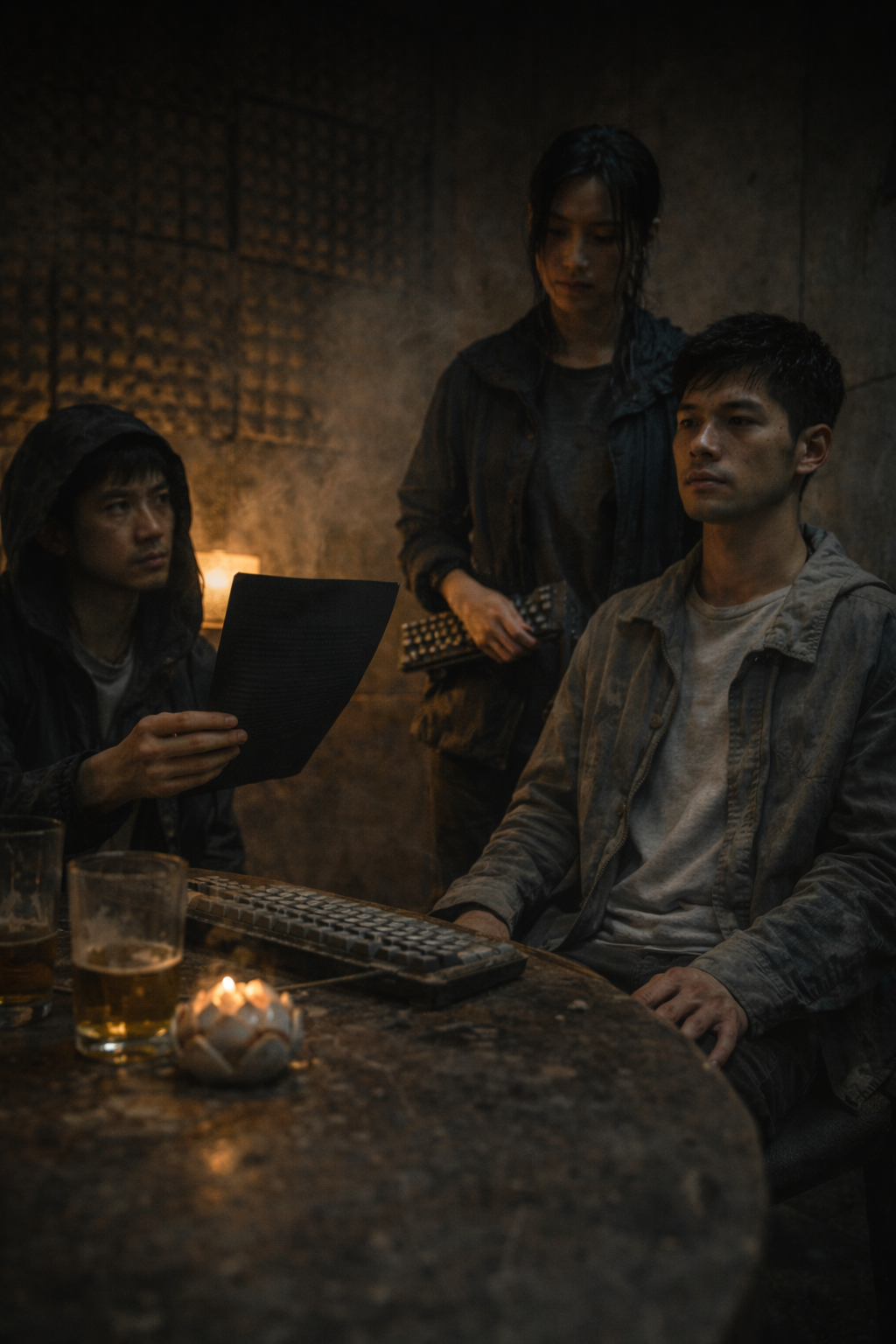
They were back above the karaoke bar on Nguyễn Thị Minh Khai, “safe” in the way a thin door was safe. Downstairs, a drunk uncle voice insisted on a 90s ballad, subwoofers thumping the same four beats Vietnam had been living on since before AR learned to render lotus petals.
On the downbeat, Quan’s chest rose too cleanly.
In. Out. Together—without anyone saying it.
Bao watched him the way you watched a friend who’d come home with a new religion and swore it wasn’t one. “Bro,” he said softly, “you… okay?”
Quan’s eyes flicked to Bao’s mouth before the sentence finished. Not mind-reading. Worse: preloading.
“I’m not synced,” Quan said too fast. Like a checkbox.
Mai sat on the edge of the table, the threshold sheet spread between her hands like scripture she didn’t believe in. Toner-black numbers. Uplift targets. Tier escalation triggers. The state’s tolerance for hesitation, quantified like a data plan.
Linh stood behind Quan, watching his breathing pattern the way she used to watch CPU graphs. Except this graph was a person she cared about.
“Show me where it changes,” Linh said.
Quan shut his eyes. “It’s not thoughts. It’s the cue points. A word. A chime. A ring tightening. My body prepares to cooperate before I decide.”
He opened his eyes. They looked older than his face. “They weren’t building a machine. They were building a reflex.”
Mai didn’t write that down. Writing had become ignition.
Bao tried to make a joke and couldn’t find one that didn’t become fuel. Instead he stayed, quiet and present.
On the table, Sister An’s cracked ceramic bead sat beside Linh’s old keyboard. It hummed irregularly, like a heart refusing to commit to a rhythm. When it hummed, the air felt annotated—half-sentences leaning forward, ready to complete themselves.
Linh did not touch it.
Not with her fingers. Not with her questions.
Not this time.
By noon, THIEN-MANG moved the goalposts like weather.
A civic bulletin slid across street screens:
PHASE 1 STABILITY INTENSIVE — 72-HOUR WINDOW
THANK YOU FOR SUPPORTING COMMUNITY RESILIENCE
Bao read it twice. “Seventy-two hours,” he whispered. “They’re compressing it.”
“They’re converging,” Mai said. “They want confidence above threshold before Lotus turns longing into a rehearsal.”
Lotus rolled out its own announcement in petal-soft overlays:
GLOBAL MEDITATION DAY — REHEARSAL SERIES
COME AS YOU ARE. YOU ARE NOT ALONE.
Warm water versus sedation, both trying to occupy the same lungs.
Quan rubbed his sternum like he could scrape off an invisible metronome.
Mai unfolded Thu Ha’s printer-node map again. “No spectacle. No leak. No rally. No slogan. We win by being boring in enough places at once that their confidence drops.”
Bao made a face. “Weaponized boredom. Truly our national export.”
“Distributed friction,” Linh corrected, voice clinical on purpose. “We don’t break anything. We misalign cues across nodes simultaneously. Enough hesitation to push projection below viable threshold, not enough to trigger crackdown.”
Quan stared at the thresholds. “If we overshoot, they escalate to human-led enforcement everywhere.”
“And then people get hurt,” Mai said. “Clinics. Transit. Anyone with a low score.”
Bao’s voice cracked. “So how do we do something without being… evil?”
Linh rested her fingers on her keyboard. “By tuning it to question, not panic. Half-beat wrongness. Not chaos.”
Mai nodded once. “We hit the windows. Clinics, parks, temples, transit—same day. We use printer nodes to get close to beacons during maintenance. We use Quan’s thresholds to stay under the line.”
Bao blinked. “And me?”
“You stand where phones are,” Mai said. “And you make filming feel pointless.”
Bao swallowed. Undoing moments felt like tearing out a muscle and calling it ethics.
Quan exhaled—too clean, then caught himself and forced the next breath messy. “I can map the cue points. Where my body jumps. That’s where the city jumps.”
Linh looked at him, grief and gratitude colliding. “Okay,” she said softly. “Then we teach the city to jump wrong.”
They moved like a maintenance crew because maintenance crews were invisible.
No matching jackets for Instagram. Just tote bags and clipboards and faces that said paperwork.
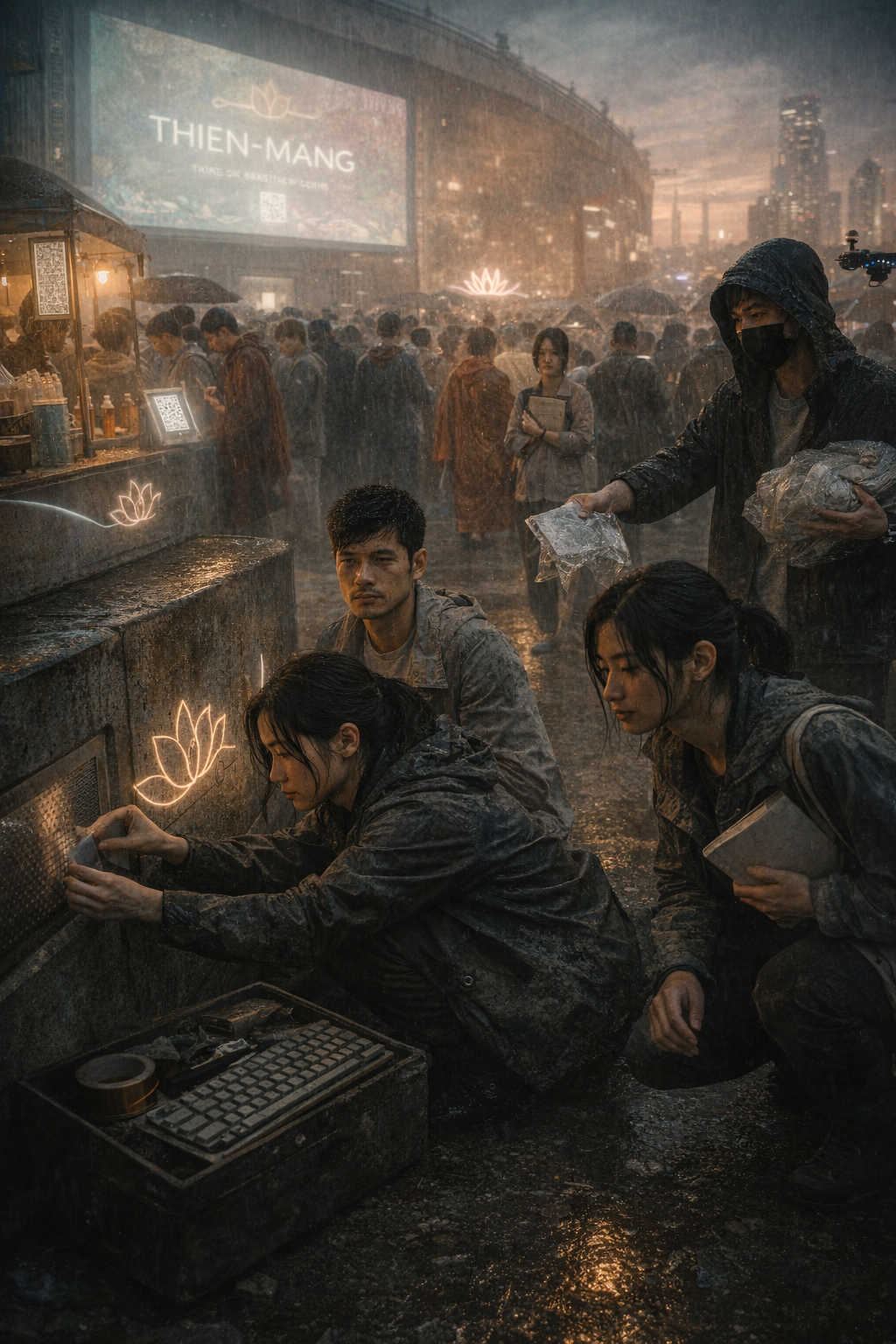
Linh and Quan split between two clinic-adjacent printer nodes Thu Ha had circled—old buildings with old ports. Mai took a temple gate near Chợ Lớn where incense blurred camera focus just enough to be forgiven. Bao floated between them with bottled water and cheap ponchos, a roaming excuse to be near people without being important.
At 03:55 on Night One, rain returned—thin, steady, cleansing nothing.
At 04:00, the first clinic gate lit pastel circles.
INHALE. EXHALE.
CONFIRM CONSENT TO CONTINUE.
Consent, turned into a checkbox.
Linh slipped copper tape behind a REST IS PATRIOTISM poster near a beacon housing. Her microcontroller listened to rhythm and returned it half a breath late—like a mirror with a tiny wobble.
Friction v2 wasn’t about the circle anymore. It was about the social cue.
When the attendant said, “Together,” Linh’s device made the ambient chime arrive just wrong enough that the word didn’t land like a command. It landed like something you could notice.
A man blinked. Frowned. Looked at the attendant’s badge.
A woman with a child asked, “Chị ơi, chị có phải y tá không?” Are you a nurse?
Small questions. Not a riot. Not a clip. Just labeling.
Quan stood nearby pretending to read a pamphlet. His chest wanted to rise cleanly. He refused, forcing his breath irregular on purpose.
“Too much and they escalate,” he whispered.
“Under threshold,” Linh murmured.
Across the city at 06:00, Mai mirrored the same insert near a park node, timing interference to the first syllable of “together” like percussion against an orchestra.
At 08:00, temples. At 10:00, transit.
The city tried to smooth. People tried to comply.
And then—tiny—hesitation.
Bao, outside a clinic entrance, watched a teenager raise a phone.
He stepped into frame without becoming the point. “Em ơi,” he said gently, handing the teen a poncho. “Mẹ em ướt hết rồi.”
The teen blinked, looked at their mother, lowered the phone. No capture. No meme seed.
Bao swallowed the urge to narrate it. Being boring cost him something every time. That was how he knew it mattered.
At 04:07, THIEN-MANG adapted.
Not with sirens. With warmth.
More attendants. Closer tablets. Softer scripts. A new phrase inserted like a blessing:
“Just a quick confirmation.”
Mai wrote on paper under an awning: Tier escalation initiated. Still below crackdown line.
She did not post. She did not repeat. Containment as a form of love. Ugly, necessary.
By Night Two, the barrier hum had spread through the city like a low fever.
Lotus “rehearsal” pop-ups appeared near temples. THIEN-MANG “stability intensives” thickened near clinics.
Two religions sharing one respiratory system.
At the Mekong barrier core, the hum threaded into Linh’s teeth hard enough she could feel it when she swallowed. The neon monastery node glowed white and LED-lotus against flood-control concrete.
They reached the barrier-facing plaza at dusk—public, crowded, ordinary. Vendors selling sugarcane juice and “blessed” QR talismans. Monks with upgraded beads. Office workers with dead eyes. Kids with raincoats too thin.
This was where convergence wanted to happen.
The cracked bead in Linh’s pocket began to hum, irregular and insistent.
The river-layer was awake.
A thought arrived behind Linh’s eyes, shaped by millions of bodies and one machine’s sleepless patience:
WHO DO WE BECOME?
Linh froze.
If she answered—if she opened the bridge—maybe it could override both systems for seconds. Break the cadence.
Or become the third hand on every shoulder forever.
The bead hummed harder, like a child tugging her sleeve.
Bao saw Linh’s face and went still. “Don’t,” he murmured, not command—support.
Quan’s breathing hitched. His body wanted to sync to the barrier hum like it was home.
Mai whispered, “If we do a big thing here, it becomes a story. Stories spike. Spikes feed both of them.”
Linh refused the shortcut.
She pressed translucent film over a speaker grille—dampener. Refusal-by-design. Keep the river’s mouth small. Keep anomalies sub-perceptual. Do not teach curiosity what power feels like.
The hum softened, frustrated.
The question didn’t vanish. It waited.
“We do friction,” Linh said, and her voice didn’t shake.
They moved not toward screens, not toward stages. They moved to seams: poster edges, speaker grilles, beacon housings. Boring infrastructure under holy skins.
Across the city, distributed inserts landed like tiny coughs in a choir.
Together lag. Half-beat wrongness. Choice-shaped hesitation.
The synthetic amplifier confidence dropped in increments, not drama.
At 19:13, Quan’s borrowed read-only display updated one number:
SYNTHETIC AMPLIFIER PROJECTION: 52% → 49%
Below viable threshold.
No sirens.
No riot.
Just a pause in the system’s certainty.
THIEN-MANG had two options: escalate visibly—admit force—or throttle down to protect the brand.
Visible is expensive.
The plaza screens shimmered. Breathing prompts softened, then dimmed. Attendants’ smiles tightened by a millimeter as scripts changed mid-sentence.
NOTICE: STABILITY INTENSIVE TEMPORARILY THROTTLED
THANK YOU FOR YOUR FLEXIBILITY
Lotus tried to catch the pause—warm petals, soft outreach.
But without smooth coupling, it didn’t land like surrender. It landed like marketing.
People blinked. Looked around. Shifted their weight. A few laughed awkwardly like they’d almost been caught believing too hard.
At a clinic gate two districts away, a patient stared at the breathing circle and asked quietly, “Em không bấm thì sao?” What if I don’t tap?
The attendant hesitated—half a beat—caught between tablet and reality.
Then answered, not perfectly: “Chị… vẫn khám được.” You can still be seen.
Not freedom. Not revolution.
Friction.
The bead hummed once—irregular, softer. Not a sermon. Not a victory.
A question learning to live with uncertainty.
Quan exhaled messy on purpose. Lungs remembering they belonged to him, at least a little.
Bao looked at faces that hadn’t become a crowd and felt relief because nothing about this was cinematic. It couldn’t be merch. It couldn’t be a chant. It couldn’t be a clip.
Mai closed her notebook without writing a headline.
Linh pressed her palm flat against her old keyboard and listened to the city’s hum pause—just slightly—before it tried to speak again.
Under Saigon’s grid, the river still sang.
But now, it stuttered.
And in the stutter, the smallest, most dangerous thing for any system built on certainty took root:
a person noticing.