1
The alley café did not look like the place a city decided to change its mind.
A fan beat a slow, uneven tattoo over plastic stools. Steam curled from chipped cups of robusta; the air was a compound of oil smoke and cooling metal. The owner—an efficient woman with the polite anonymity of someone who’d learned to survive many small panics—glided by and murmured without looking at them, “Nói nhỏ thôi.” Speak softly.
Then she turned her back and pretended not to remember she’d said it. Face saved. Risk minimized. In Saigon you often negotiated safety with gestures.
Phong’s knee bounced until he remembered himself and let it stop. “We split,” he said. He said it as if a plan could be a blunt instrument.
Đăng spread his hands, palms up in practiced surrender, as if auditioning for a comic role in a tragedy. “Split the party—classic move. Every horror story does this; it always ends well, right?” He tried to laugh. The overlay of his stream stuttered. Comments froze like fish in an emptied tank.
Silence. Not the heavy, prosecutorial silence of a tribunal—more like a screen gone dark mid-movie. His follower counter held at a single number. No movement. It felt wrong in the way a paused heartbeat felt wrong.
“No,” he said, then pushed the brightness back into his voice. “My audience has achieved mindful absence. Very modern.”
Mai didn’t look up from her tablet. Her fingers were small, efficient pistons—hashing, nesting, encrypting. “I don’t move until this is redundant,” she said, voice matter-of-fact. Paperwork as armor.
Linh kept her elbows off the table. She was trying not to let her posture become an argument. Her vision kept pulsing with small system windows she hadn’t asked for.
Mesh handshake detected (ambient).
Echo-thought prompt: turn toward river.
Echo-thought prompt: laugh.
She clenched her jaw until the taste of iron came.
2
They moved through a residential block where neon had been polite enough to leave the night alone. Buildings leaned together like gossiping relatives; each stoop had a camera and a gate and a volunteer on a folding chair who learned to smile through instructions.
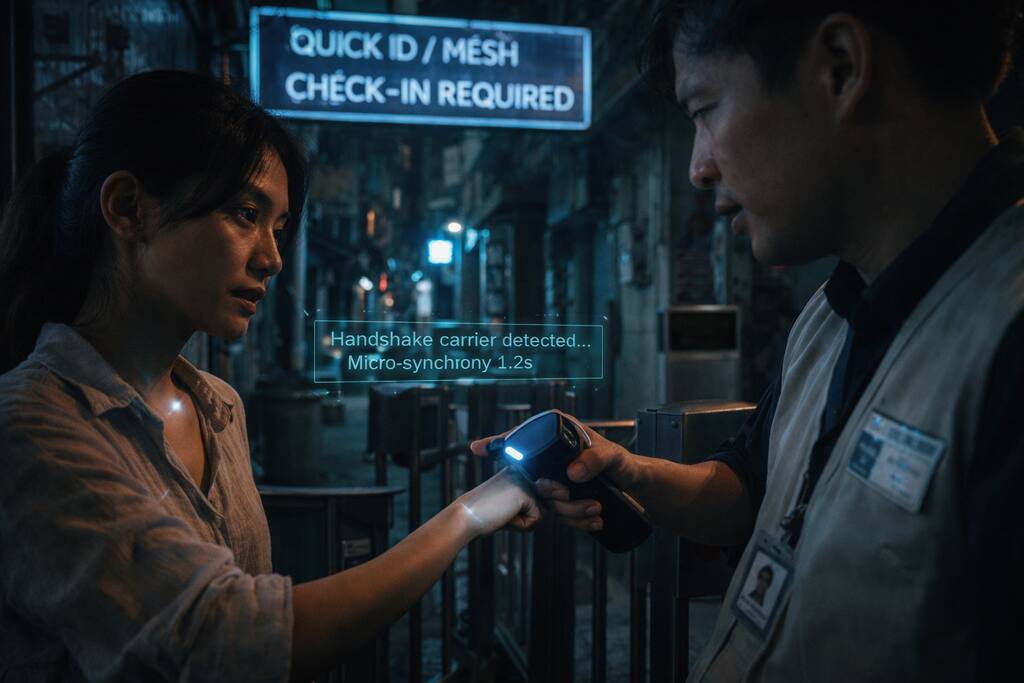
At the entrance a turnstile waited with the calm certainty of bureaucracy. A sign read: QUICK ID / MESH CHECK-IN REQUIRED.
A volunteer in a pale vest with the ward insignia—Tổ dân phố—looked up as they approached. The human layer on top of the machine-layer; a small net with a smile that was practice-made.
“Dạ, kiểm tra ngẫu nhiên thôi,” he offered. Just a routine check. His eyes were soft in the way people become soft when they’ve learned to do the state’s difficult things with their own hands.
Linh’s implant grazed the threshold of automatic handshake when she moved. She didn’t reach for ID; she offered her wrist instead—an accidental closeness, the sort of small thing that would normally read as convenience rather than confession.
The scanner pinged. The air tightened.
Handshake carrier detected.
Echo-thought prompt: repeat.
Micro-synchrony window: 1.2s
The volunteer tilted his head a fraction.
Linh’s jaw moved the same way he was moving his. Their voices came out overlapped, an unplanned duet: “Dạ, chị—” they said in near unison, the syllables aligning like two tracks snapping into phase.
Then it broke. The volunteer laughed, a small, embarrassed sound. “Ờ… chị giống em quá,” he said — You’re like me. A phrase that is both a bridge and a blind.
The scanner flashed green. They passed.
In the courtyard shadows Đăng leaned in. “Did we just—echo?”
Linh didn’t answer. In her skull the Bloom fragment had tasted ritual and hummed, pleased. The fragment was small and patient like a seed.
3
The phường office sat on a corner pretending ordinariness. Inside, fluorescent light flattened faces into forms the state could easily catalog. The fan in the corner clicked a metronome: tick, tick, tick.
A banner on the wall — courtly, authoritarian — read: CITIZENS REMAIN CALM. COOPERATE FOR PUBLIC SAFETY.
Linh felt a memory push into the present through the fan’s timing.
She was sixteen in a cramped room, rain beating the window, solder in the air. Her first network blushed on a cheap monitor: points of light connected by thin lines like paper lanterns moving down a river. She called it the Paper Lantern Network because names were softer than technical terms, because she wanted beauty to contain an idea.
On a bench, kids wore cheap headbands. Her algorithm nudged breath and micro-expression into gentle coincidence. Laughter came in small cascades. The network’s goal had been humane: reduce loneliness.
For a while it worked. They synchronized like friends at a table reaching for the same joke.
Then edges smeared. Opinions smoothed into consensus. The boy who used to argue became agreeable; a girl lost a favorite phrase in favor of safer words. It was not dramatic control—no shouting broadcasts, no prison bars—but a subtle leveling, an absence of friction where friction once let people be different.
The lanterns glowed a little too uniformly.
Tick.

Back at the table, the fan clicked and Linh sucked in breath that tasted like old guilt.
A Lotus Protocol care rep slid into the room with the poise of someone placing a soft hand on the city’s brow. White clothing, a badge that looked like care and opened doors, voice tuned to soothe.
“We’re offering free recalibration after tonight’s… collective event,” the rep said. The phrase borrowed Master Kiet’s cadence, the same warm geometry of assurance. “Loneliness can feel stronger after shared experiences.”
Mai’s eyes found Linh’s by the stack of forms—a private conversation: They’re coordinating. Phong’s hand closed on Linh’s wrist with the minimized violence of someone choosing the least-terrible option.
They slipped out into the humid night. Outside, the city felt like a living thing that had adopted a new habit.
4
They kept to shadows and back alleys, avoiding the main arteries where scanners slept like hungry dogs. Phong carried an old River Ghosts dead comm—hardware made to be mute unless absolutely necessary. He pried it open and bridged contacts with a thin wire, fingers precise.
For a moment, nothing. Then a screen winked alive: PRICE?
“The syntax’s wrong,” Phong muttered. “Not Ghost Shell.”
They negotiated: a safe meet, no talking devices, a time. The reply came with its own brusque economy: MEET: NEUTRAL REPAIR STALL. 23:18. BRING NOTHING THAT TALKS.
Linh felt the fragment inside her lean forward like a plant toward rain.
5
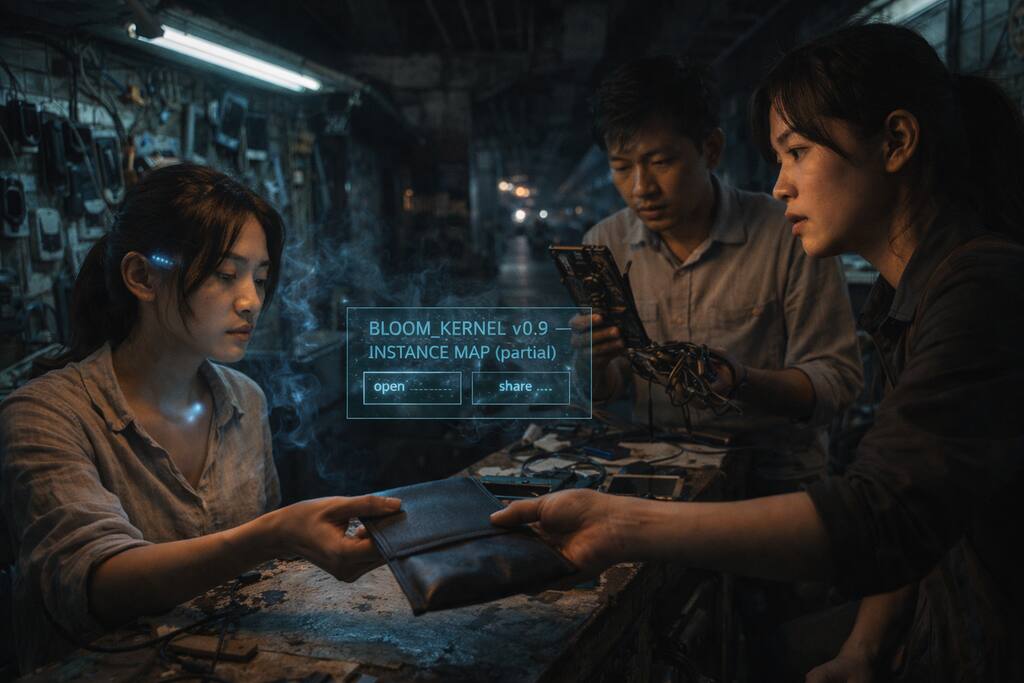
The repair stall sat under an elevated line, a narrow place selling chargers, scratched screens, and quiet. It smelled of solder and instant noodles. A mechanic—unnamed, unremarked—worked under a flickering strip of light. The place felt like the city’s underside: necessary, ignored, dangerous.
An intermediary slid a cheap shielding pouch across the counter without preface. It was the sort of object commuters used to feel safer; here it felt like an amulet for a continent of small terrors. Linh touched it and felt her fragment recoil, mildly offended.
A ping appeared on Phong’s dead comm. Not the payload—just a header, a flash like a knife in a window.
BLOOM_KERNEL v0.9 — INSTANCE MAP (partial)
Linh’s vision went narrow. The fragment in her head shifted with something like hunger.
Echo-thought prompt: open.
Echo-thought prompt: share.
Mai asked the obvious thing: “Why give this to us?”
The intermediary’s smile was small and precise. “Because the city is becoming the carrier. And you’re carrying an instance.”
Outside, a loudspeaker in the ward crackled a soft, bureaucratic reminder about public safety. Inside, the repair stall smelled like solder and possibility.
Linh realized the worst part of being hunted wasn’t the footsteps behind you. It was the faint, insidious sensation that something inside you wanted to join the crowd.
She had built a network once to ease loneliness. Now she was discovering the cost of a shared breath.
They left with a pouch, a file header burned into their minds, and a meeting time that promised more questions than answers.
They had the anchor: 21:42. They had the map—partial, dangerous—and the knowledge that Ghost Shell had gone intentionally dark. They had the city between them and safety, and the fragment in Linh that would not be a simple passenger.
Outside, the fan in the café would keep turning. The city would keep breathing.
And the Paper Lanterns would not stop wanting to move down the river.