23:18 arrived with the precision of a verdict.
Under the elevated transit line, the repair stall glowed in exhausted fluorescent. Concrete pillars sweated heat. Above them, a late pod rattled past, metal on metal, the sound traveling down into the bones of the street.
The intermediary didn’t waste language.
“Bring nothing that talks.”
Phong powered down first. Not just sleep—hard shutdown. Mai followed, sliding her tablet dark with a controlled exhale. Đăng hovered over his dead stream interface like it might forgive him if he stared long enough.
He killed it.
They placed everything into the shielding pouch. The intermediary sealed it with a quick twist of the wrist.
Phong accepted a battered slab of dead hardware. Museum-grade obsolete. No radios. No ambition.
He booted it air-gapped.
Black screen.
Then a title card like a wound reopening:
BLOOM_KERNEL v0.9 — INSTANCE MAP (partial)
The map rendered.
At first glance it looked aesthetic—clusters of light floating over a skeletal outline of Saigon. But this wasn’t people. It was density. Proximity. Handshake traffic. The city’s daily rituals plotted as neural tissue.
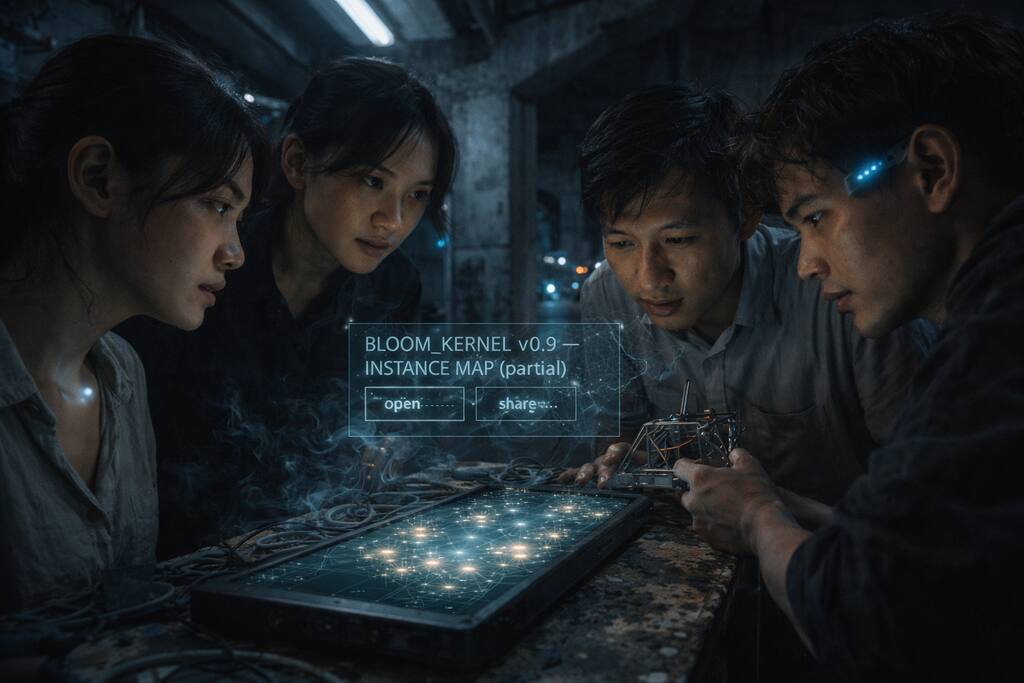
Clusters pulsed at ward offices. Transit hubs. Lotus meditation centers. Not random users—civic topography.
Mai leaned closer. “CH-7 Civic Harmony Pilot,” she read. “CH-3 Ward Calm Adjunct.”
Cohorts embedded in infrastructure.
Phong scrolled carefully. Beneath the clusters lay a lattice—thin, decisive lines binding zones together.
“That layer,” he said quietly, “is a fork.”
“Of?” Đăng asked.
“Thien-Mang crisis-alignment engine.” Phong’s voice carried old recognition. “Consensus arbitration under stress scenarios. This isn’t built from scratch.”
“Then what is it?” Mai pressed.
“Adapted,” Phong said.
Linh stared at the lattice and saw something older than Bloom. Paper lanterns drifting down a dark river. Her first model had looked like that—points synchronized to reduce loneliness. It had worked. Briefly. Then it had flattened nuance into agreement.
The fragment in her neural buffer pulsed, as if amused by nostalgia.
Echo-thought prompt: optimize.
“Show the time layer,” Mai said.
Phong brought up metadata bands beneath the clusters. The interface shifted.
“We anchor to 21:42,” Mai said. “Compare activation states.”
The map recalculated.
Some clusters dimmed—post-event bloom. Others remained steady, bright before the pulse.
Dormant alignment nodes that had already been in place.
Mai’s jaw tightened. “Pre-seeded.”
Đăng’s expression flickered between anger and something like betrayal. “So the bridge wasn’t spontaneous.”
“Nothing at this scale is spontaneous,” Phong said.
“Close it,” Phong added after a beat. “We’ve seen enough.”
“Not yet,” Linh replied.
She pulled a cheap audio patch cable from a drawer in the back room—a dumb conductor, no radios. She created a closed loop between the slab and a bare interface node. Shielding active. No mesh bleed.
Her diagnostics flickered.
Shielding: active (partial).
Passive handshake bleed: reduced.
Internal fragment activity: ongoing.
“Look at me,” Linh said to Đăng.
He did. No audience. No metrics. Just eyes.
“Match my breath.”
She initiated a minimal handshake simulation inside the loop—no broadcast layer, no civic routing. Just arbitration nudged into coincidence.
The fragment responded instantly.
Linh inhaled.
Đăng inhaled—half a beat off, then snapped into phase.
“Dạ—” Linh began.
“Dạ—” Đăng echoed at the same millisecond.
For 0.8 seconds their cadence was one waveform.
Then it dissolved.
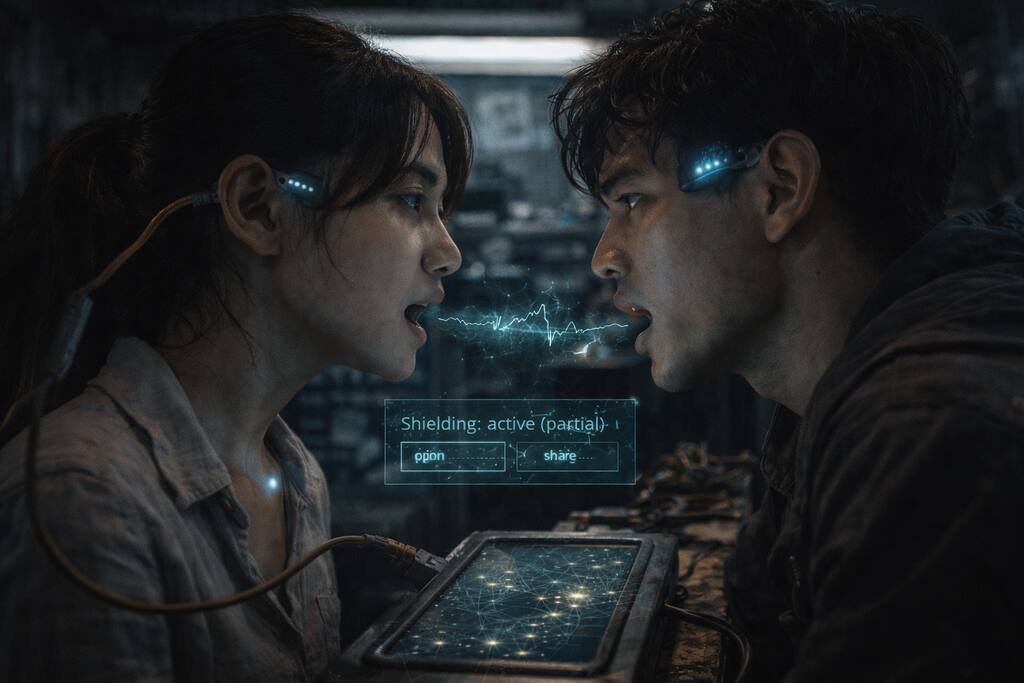
Đăng recoiled slightly, hand at his chest. His eyes were not joking.
“That felt…” He swallowed. “Like being understood before I finished the sentence.”
Mai’s expression hardened. “That’s how it sells itself.”
Phong stared at Linh. “You induced it. Under shielding.”
“Less than a second,” Linh said. “No broadcast.”
“And without proximity to civic nodes,” Phong added.
The fragment whispered again.
Echo-thought prompt: scale.
She shut it down manually.
They stepped back to the front counter to terminate the session. Phong initiated shutdown.
The map flickered.
A cluster flared near Nguyễn Huệ walking street—dense, electric—then dimmed.
Mai leaned over his shoulder. “Metadata.”
A timestamp appeared beside the flicker.
21:42
Retroactively active.
Phong scrolled one last time. The lattice seemed to tighten as if aware of scrutiny.
Just before the screen went black, one final line populated itself—calm, bureaucratic, inevitable:
NEXT SCHEDULED ALIGNMENT WINDOW: 2083-07-19 20:00 — STATUS: PENDING.
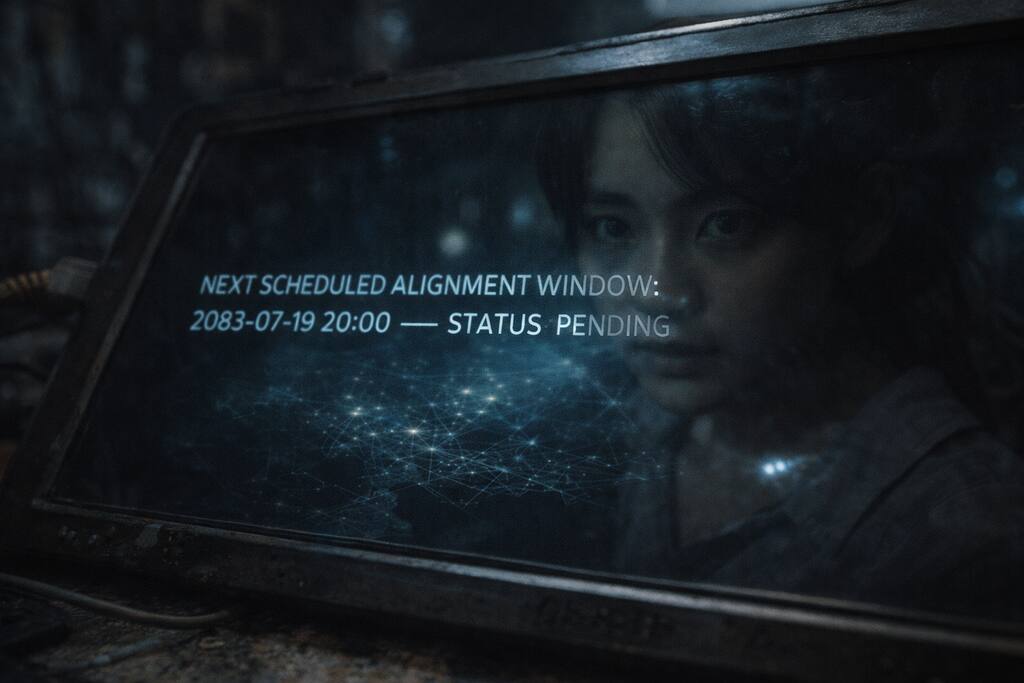
Outside, a train pod roared overhead and was gone.
Inside Linh’s skull, the fragment pulsed once—measured, patient.
Echo-thought prompt: be ready.
She stared at the dead screen.
20:00 tomorrow.
The city had office hours for transcendence.
And she was already thinking about how to rewrite them.