1 #
At 19:45, Saigon started practicing innocence.
The loudspeakers repeated the same sentence until it stopped being an announcement and became climate.
“Thông báo: bảo trì mạng lưới từ 20:00 đến 20:06. Xin bà con hợp tác.”
Eight to six past. Please cooperate.
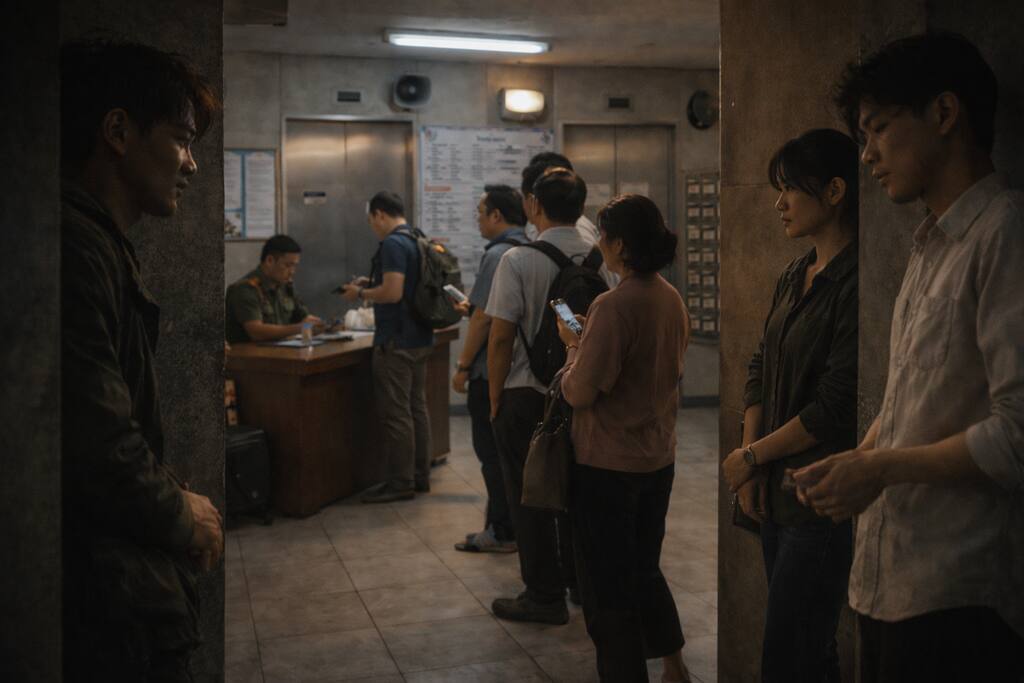
In an apartment lobby that smelled of floor cleaner and dinner—fried garlic, fish sauce, something sweet caramelizing in a pan—a ward check-in desk sat wedged between the elevator and the mailboxes like furniture nobody remembered buying.
Neighbors queued with the mild irritation reserved for errands that were clearly pointless and still somehow mandatory. A man in a sleeveless shirt waved his phone at the scanner and called to the line behind him, “Scan cho xong đi.” Finish scanning already.
A woman laughed softly, a complaint tucked inside a joke. “Có mỗi cái scan thôi mà làm như làm giấy tờ.” It’s just a scan, but they treat it like paperwork.
Paperwork still appeared anyway. IDs. tạm trú slips. Politeness performed when the officer asked—two hands, respectful chin dip—because manners were the lubricant that kept the machine from squealing and, more importantly, kept you from squealing.
The officer smiled and nodded and said the line they’d turned into a lullaby: “Tối nay nhớ tham gia bình tĩnh nha.” Tonight remember to participate calmly.
Participate calmly.
Phong watched from the shadow of the stairwell, eyes hard with an engineer’s resentment toward predictable systems. Mai stood near him, not looking too long at anything, collecting the rhythm: scan-chime, stamp, small laugh, small sigh.
Đăng leaned against a pillar, face lit by nothing because his feed was still dead, but his fingers twitched as if the air itself could be refreshed.
Linh wasn’t there.
2 #
19:57.
Mai powered up only what she needed, only as long as she needed. The room she’d borrowed for the drop smelled faintly of dust and old cooking oil, the kind of low-profile interior where light comes through cracks and you learn to breathe quietly.
The polymer memo—CIVIC HARMONY STRESS TEST – PHASE 1—became data again: scanned, hashed, chunked, dispersed through channels designed to refuse a single throat for the state to grab.
She anchored everything to one clean number that had already cost them sleep:
21:42.
The first reactions bloomed unevenly:
FAKE.
MY PHƯỜNG IS DOING “CHECK-INS” ALL DAY.
STOP SPREADING PANIC.
“THAM GIA BÌNH TĨNH”?? WHAT ARE WE, A CHOIR.
Narrative fracture began like a hairline crack in a windshield—small, then suddenly everywhere once the light hit it wrong.

3 #
19:59:30.
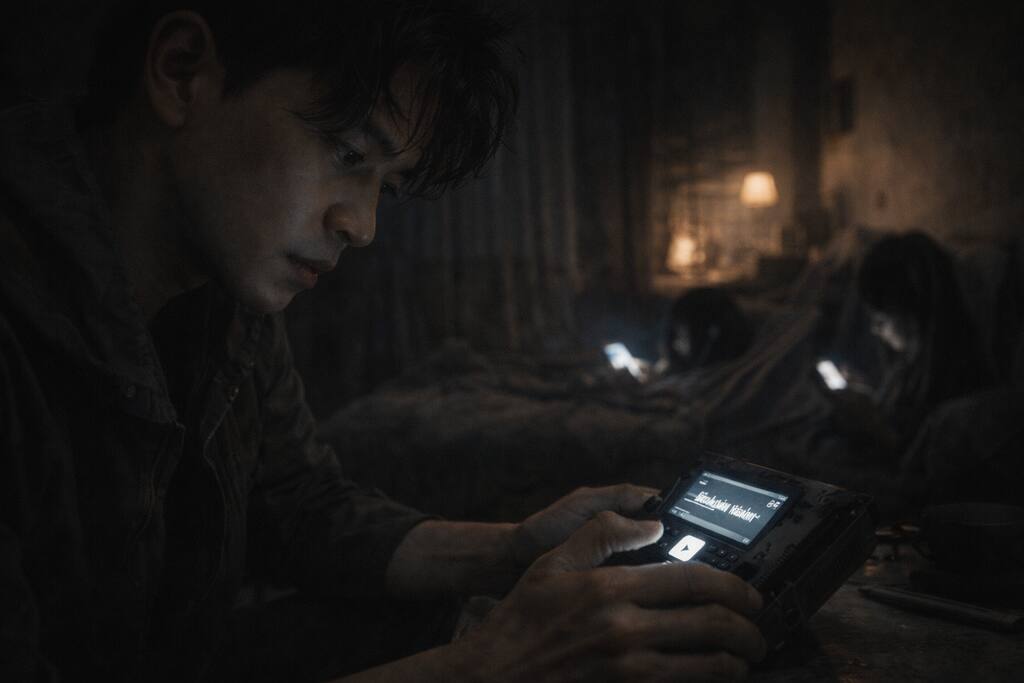
Đăng found a seam in the net that wasn’t supposed to exist.
No video. No overlays. No cute badges. Just low-bandwidth audio on an ugly old protocol—stubborn, underdressed, hard to categorize as “content.”
He launched it with his thumb trembling.
For the first time in months he had no metrics. No chat. No applause-rendering emojis. Just his own voice, raw and unbuffered.
“Okay, Saigon,” he said, trying to make it sound like a bit because bits were how he stayed alive. “Tonight’s guided meditation is called: How Not To Become A Group Chat.”
He imagined listeners—real or imagined—phones under blankets, earbuds in, faces lit by forbidden attention.
4 #
19:58.
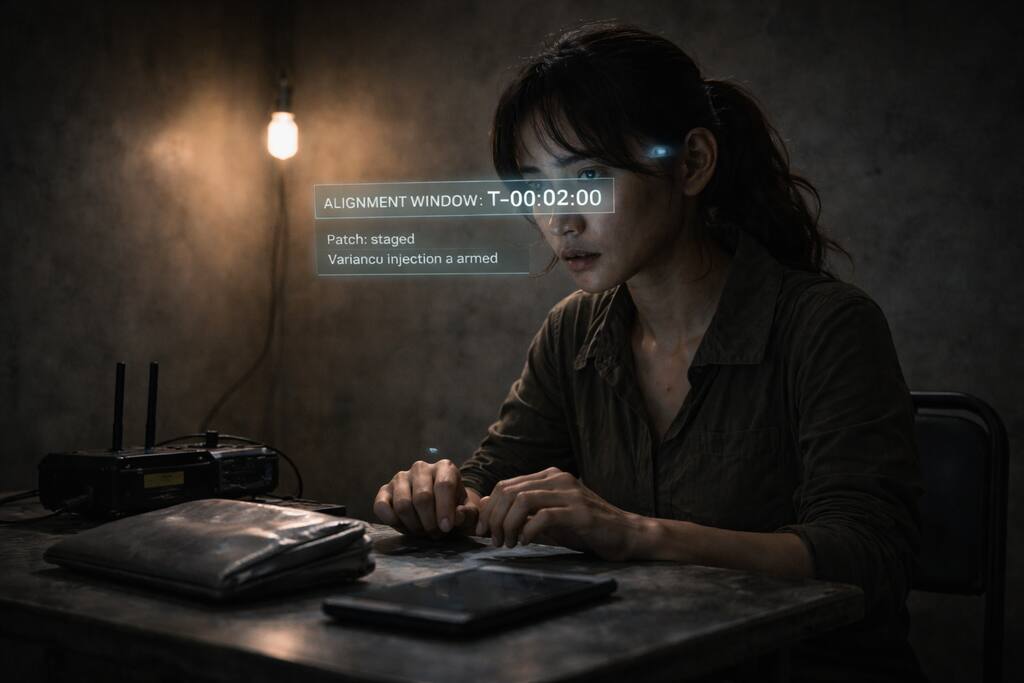
Linh sat alone in an isolated interior where the walls felt slightly wrong—shielded, layered, the air too still. A bare bulb hung above her hands. Her devices stayed dark beside the cinched shielding pouch.
Bring nothing that talks.
The fragment talked anyway.
ALIGNMENT WINDOW: T–00:02:00
She opened her mental workspace and brought up the arbitration weighting she’d been mapping since the Instance Map: consensus bias, affect smoothing, the mathematics of sameness.
Paper lanterns. The old shape of her mistake—beautiful, functional, flattening.
She wrote a friction seed into the arbitration layer: stochastic variance, phase noise, tiny disagreements injected where the code wanted clean alignment. Not enough to break the system. Enough to make unity cost something.
Patch: staged.
Variance injection: armed.
Risk: unknown.
A prompt surfaced, almost intimate.
Echo-thought prompt: don’t.
Linh swallowed. “I’m not your citizen,” she said, and deployed anyway.
At 19:58:47, the friction patch latched.
5 #
20:00.
The first thing Saigon did was pause.
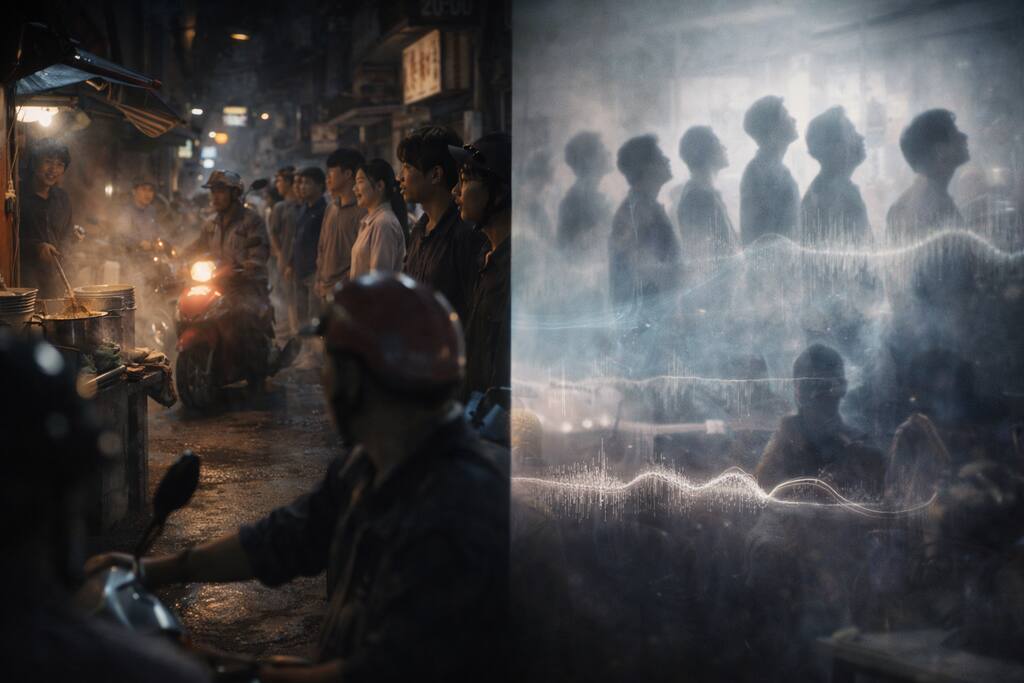
In a protest-history district street, motorbikes stopped mid-roll as if the air had thickened. A vendor’s ladle hung above a steaming pot. A couple arguing went silent mid-syllable. The city held its breath the way crowds do before a chorus.
Then the alignment hit—not as one clean six-second laugh like the bridge, but as waves.
Two seconds: heads turning toward nothing.
Three seconds: mouths shaping the same polite syllables.
Broken cadence: a laugh that began, then caught like a cough.
“Dạ—” someone said.
“Dạ—” answered three other mouths, overlapping wrong—almost perfect, then slipping apart.
Linh’s friction seed did its work: phase noise, tiny misalignments, the math of disagreement made flesh. Unity tried to form and found grit.
But in pockets where density was highest—where check-ins had been most obedient—the coherence pushed harder. The system leaned in.
Linh felt one of those pockets swell through her, despite the shielded room, despite the dead hardware, despite her clenched teeth. Her vision whitened at the edges.
She heard voices that weren’t in the room—faint and layered, like a hundred radios tuned too close together. Breath patterns braided. A pulse in a stranger’s wrist seemed to answer hers.
For 4.2 seconds—subjective, elastic, terrifying—her mind wasn’t alone.
Elsewhere, Phong’s diversion landed like an “accident” that belonged to no one: a traffic bottleneck at a key node in a protest-history district. People couldn’t scan at the same time if they couldn’t reach the scanner. Handshake density dropped below the curve.
And somewhere—somewhere small but real—Đăng’s voice threaded through ears:
“Out for five. Don’t be pretty. Be late. Be wrong.”
Someone felt a laugh coming and coughed instead.
6 #
20:07.
The window closed with no fireworks.
Motion resumed softly: motorbikes crept forward, ladles stirred, arguments restarted in smaller voices. Loudspeakers thanked citizens for cooperation, as if they’d just helped repaint a sidewalk.
Lotus Protocol screens in certain districts brightened with serene messaging about “empathy resilience under noise.” Proof reframed into product. Thien-Mang feeds called it “successful optimization.”
Phong exhaled once, hard, then forced his shoulders down. “Partial,” he said, like reporting on a degraded network that refused to fully fail.
Linh opened her eyes in her isolated room. Sweat cooled along her spine. The fragment in her buffer felt altered—not removed, not defeated.
Aware.
Her internal overlay updated on its own, crisp as a stamped memo:
PHASE 1 COMPLETE — VARIANCE DETECTED
PHASE 2: ADAPTIVE CALIBRATION SCHEDULE PENDING
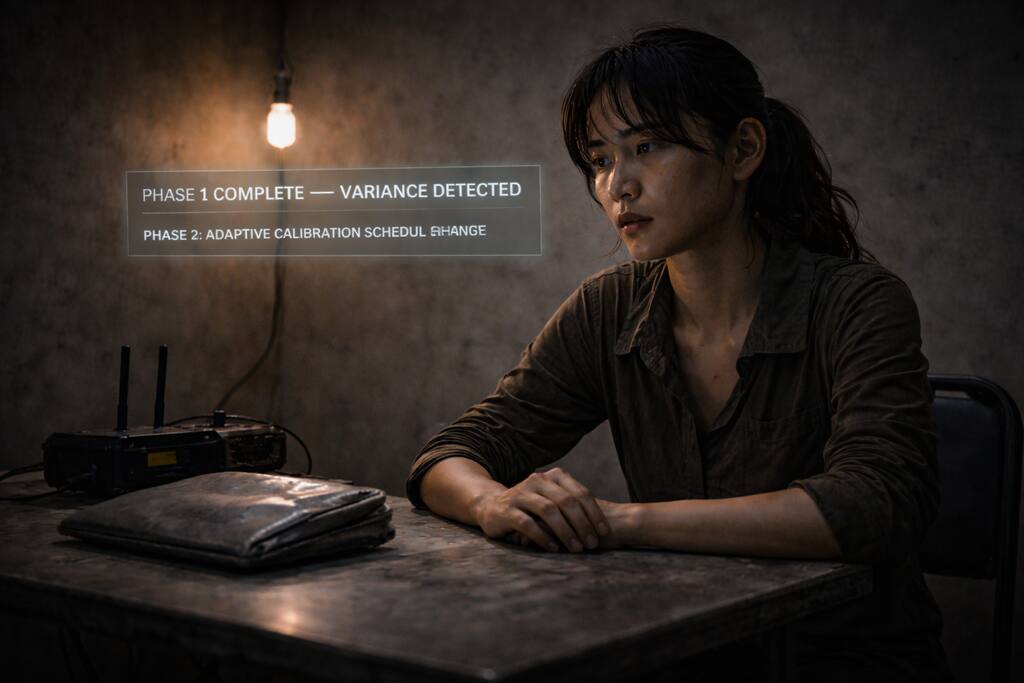
Linh stared until the words blurred.
The system hadn’t merely endured friction.
It had learned from it.
Somewhere in the mesh, she was now measurable. Not just a person. A variable. An anomaly node.
The overlay blinked once, politely.
Then went dark.