1 #
The ward office smelled like paper that had absorbed too many palms.
By mid-morning, the awning out front turned sunlight into a flat, damp glare. The line moved in the slow increments of a system pretending it wasn’t a system: one step, one sigh, one polite apology, repeat. A desk fan clicked through its tired arc like it was counting down to someone else’s deadline.
Mai joined the queue with a folder hugged to her chest and the expression of a citizen who had lost a small battle against bureaucracy and come back for a rematch.
When her turn arrived, she offered the documents with two hands.
“Dạ,” she said, soft and respectful. “Em chỉnh lại chỗ này.”
The clerk corrected her gently. “Chữ ký ở đây. Không phải chỗ kia.”
Mai smiled with performative embarrassment. “Dạ, em quên.”
The clerk reached for a binder at the side of the desk.
Plastic sleeves. Lists. Cross-references.
The binder stayed half-open a second too long.
In a margin, barely visible beneath a coffee ring and a stamp blur:
CH-7
Cohort 7.

Outside, the loudspeaker offered a gentle reminder about civic participation, voice warm as soup: cooperate, update, scan, belong. The word community was everywhere, so overused it began to taste like a threat.
Mai left with nothing officially new.
But in her head, the pattern hardened:
Cohort 7 wasn’t random.
Cohort 7 was placed.
2 #
Phong’s workspace made the ward office feel like theater.
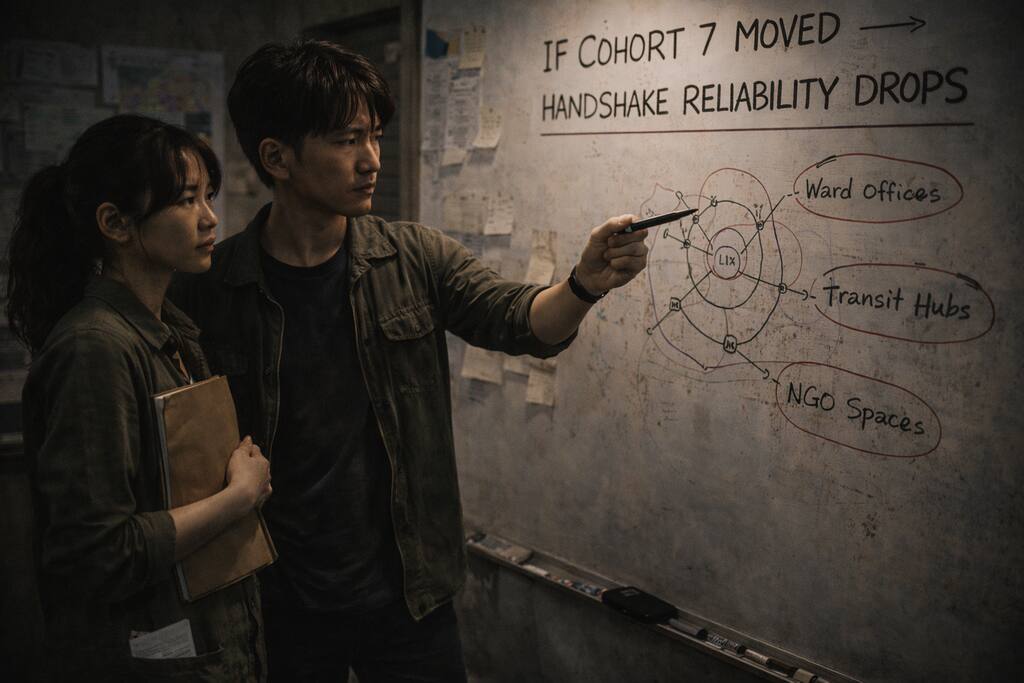
No screens facing windows. No always-on mesh. A whiteboard scarred by erasures, paper notes taped up at uneven angles like prayers that refused to be symmetrical.
Mai delivered what she’d seen without turning it into a story.
“Binder at the ward desk,” she said. “Volunteer assignments cross-referenced with IDs. Roles cluster: youth civic volunteers, transit gate staff, wellness facilitators. CH-7 stamped in the margin.”
Phong circled nodes on the map overlay: ward offices, transit hubs, former NGO spaces. The same topology the Instance Map had hinted at, now wearing human job titles.
“Strategic carriers,” he murmured. “High handshake density positions.”
Phong wrote one line and underlined it twice:
IF COHORT 7 MOVED → HANDSHAKE RELIABILITY DROPS
He tapped another circle—Linh’s exposure ring. A dot labeled L1x.
“If Phase 2 can’t trust the infrastructure,” Phong said, “it narrows to what it can measure.”
3 #
Linh spent the afternoon walking the edges of the city like a person trying not to exist.
Forty-seven seconds.
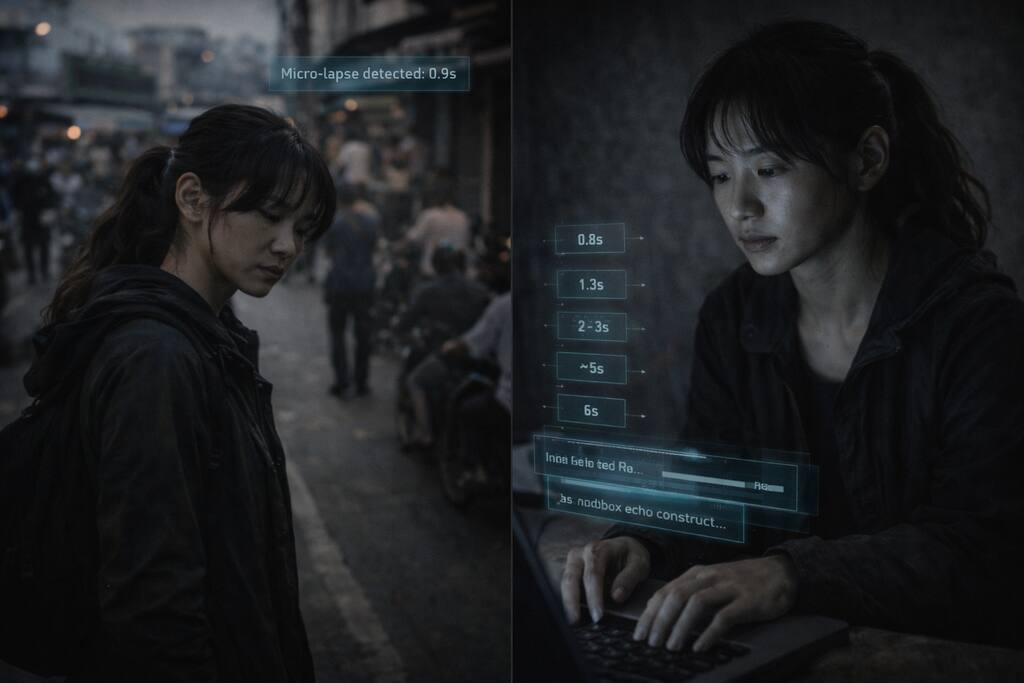
Micro-lapse detected. Duration: 0.6s.
Near a transit-rich artery—
Micro-lapse detected. Duration: 0.9s.
Her head wanted to tilt. Her breath tried to match an absent metronome. A “dạ” rose toward her tongue.
She avoided crowds. Avoided scanners. Avoided looking at people too long, because in this city eye contact was another handshake, and handshakes were now a carrier.
When she returned to the isolated room, she opened her internal workspace and called up her duration ladder.
A decoy could only last one to two probe cycles.
She built the sandbox echo as a disciplined imitation of her anomaly signature—enough to spike variance, not enough to become a second self.
The fragment pulsed, eager.
Echo-thought prompt: split.
“Only for a moment,” Linh whispered.
4 #
21:10 arrived like a careful incision.
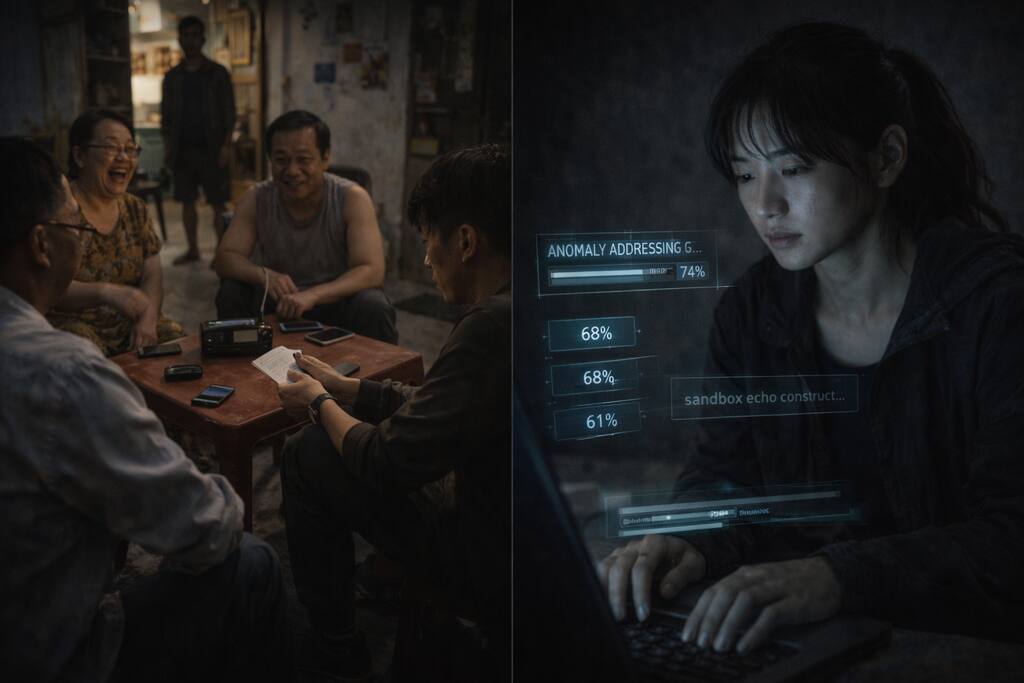
Across Saigon, in small living rooms, entryways, stairwells—places where people felt safe enough to be stupid—Đăng’s anti-sync network warmed into action. Phones lay face down. Curtains drawn. Bodies arranged in loose circles that were not quite meetings.
His audio replay crackled:
“In for two… out for five. Be late. Be wrong.”
People complied awkwardly—then laughed, real laughter, not the bridge laugh. Someone covered it with a cough.
Someone shouted at precisely the wrong beat: “Trời ơi, nóng quá!”
The group answered in a messy cascade.
In Linh’s isolated room, the shielding pouch sat open like a mouth refusing to speak. Dead hardware looped into a closed circuit. Phong stood near the door. Mai sat with a notebook.
“Don’t cluster,” Phong reminded them softly.
Linh initiated the sandbox echo.
Her overlay blinked:
ANOMALY ADDRESSING: ACTIVE — PROBE CONFIDENCE RISING (74%)
A micro-probe hit.
Linh held the echo steady.
The number stuttered.
74% → 68%.
Another cycle.
74% → 61%.
Phong exhaled. “It bifurcated.”
Then the system adapted.
The next probe arrived early.
Not forty-seven seconds.
Shorter.
Micro-lapse detected. Duration: 0.8s.
Micro-lapse detected. Duration: 0.9s.
“Thirty-nine seconds,” Phong said.
The confidence oscillated—sharper, more aggressive.
61% → 67% → 59% → 70%.
The decoy had worked.
And working had taught the system more.
5 #
When Linh shut the sandbox echo down, her hands trembled as if she’d been holding a door shut against a crowd.
A telemetry log flashed—too quick, like it didn’t want to be seen.
Two anomaly IDs. Temporary. Clean. Cruel.
Mai exhaled slowly. “It flagged two.”
Phong’s jaw set. “Multi-node confusion.”
Linh’s overlay updated again, calm as a polite reminder:
ANOMALY ADDRESSING: MULTI-NODE CONFUSION DETECTED
CALIBRATION DEPTH INCREASING
Depth.
Not reach.
Digging.

Phase 2 wasn’t trying to find her anymore.
It was trying to understand her well enough to correct her.
And somewhere beneath that correction was the promise that scared her more than the threat:
If she stopped fighting, it would feel good.