1 #
By late morning, the neighborhood told the truth the way it always had: sideways, with ice clinking to cover the sharp edges.
Mai sat near the mouth of a hẻm where shade pooled like spilled tea. Plastic stools low enough to humble you. A chipped saucer of sunflower seeds. Somewhere behind a half-open door, a fan clicked through its tired arc like it was keeping time for someone else’s schedule.
Two older neighbors talked in that careful Vietnamese that lets you trade information without admitting you’re trading information.
“Bữa nay yên yên ha.”
“Yên cái gì. Mấy đứa nhỏ đi tập huấn hết rồi. Tập huấn… gì đó.”
“Nghe nói ‘cộng đồng’. Workshop sức bền… cái gì đó.”
“Đi xa. Ngoài kia. Gần bến xe hay bến gì.”
A small laugh bubbled up between them—quick, polite, harmless—then broke apart like they’d both realized it had landed too neatly.
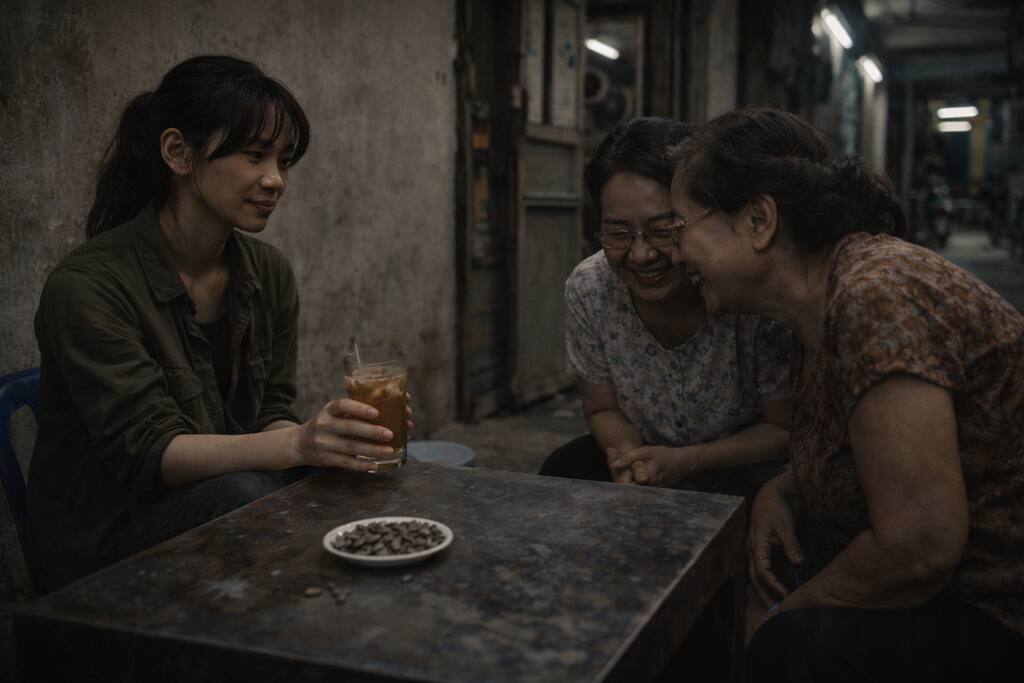
Mai finished her tea slowly, as if she had all the time in the world.
In her head, Cohort 7 stopped being a margin stamp and started becoming a van schedule.
2 #
Phong turned rumor into geometry.
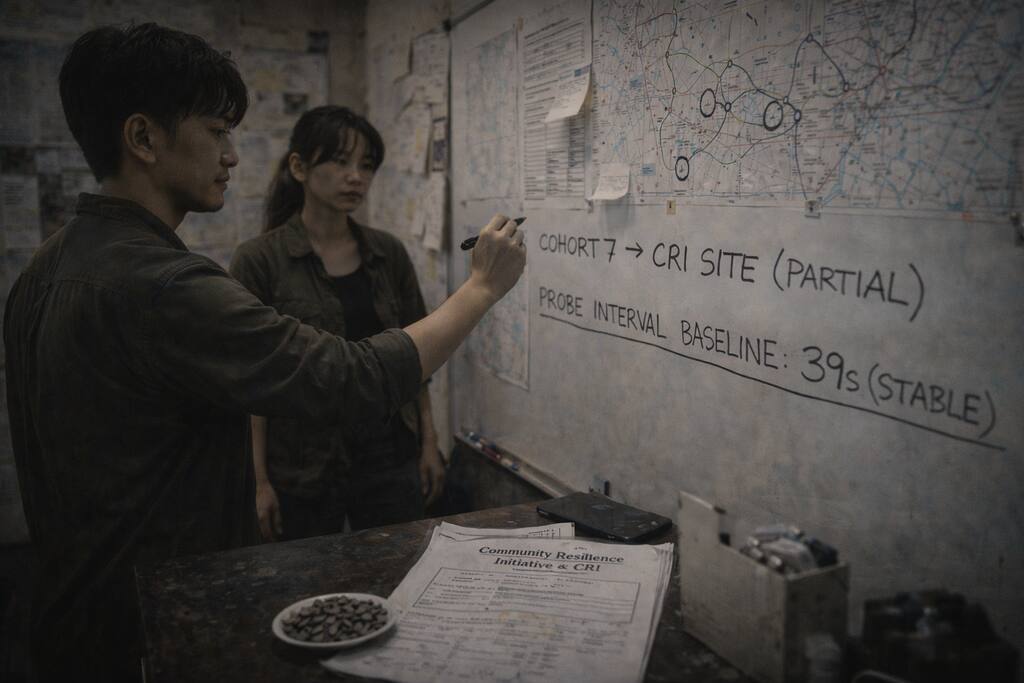
His air-gapped workspace made daylight feel irrelevant: whiteboard, printouts, taped overlays of ward boundaries and transit arteries. Paper everywhere, like the room refused to let information become a signal.
“Community Resilience Initiative,” Mai said. “CRI.”
Phong slid a printed registry extract across the table.
“Mobile workshops,” Phong said. “Peri-urban districts. Positioned near transit depots, outside the central protest zones.”
“Relocation,” Mai murmured.
“Controlled density,” Phong corrected, circling points on the map: a depot, a ward-adjacent facility, a former NGO address repainted and rebranded. “You don’t relocate people to free them. You relocate them to measure them.”
Phong tapped a small note:
PROBE INTERVAL BASELINE: 39s (STABLE)
“The decoy changed the baseline,” he said. “Permanent shift.”
“So even our resistance becomes training data,” Mai said.
He wrote:
COHORT 7 → CRI SITE (PARTIAL)
“We go as participants,” Mai said.
3 #
The workshop site smelled like lemongrass cleaning solution and paint that was trying too hard.
It sat near a transit depot that hummed with buses and routine—not abandoned, not popular. Strategically mediocre.
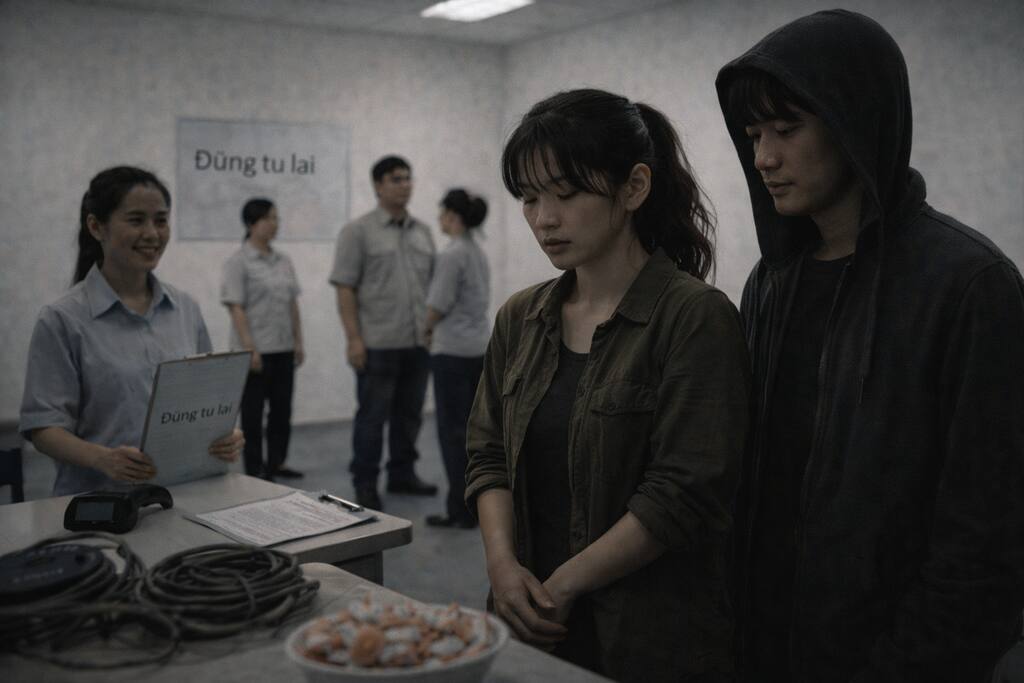
Inside, the registration table waited: stacked forms, a clipboard, a handheld scanner resting face-down as if it were sleeping. A bowl of wrapped candies that said we are nice people.
The facilitator held out the clipboard.
Mai accepted it with both hands and offered her ID the same way.
“Dạ. Em đăng ký.”
Đăng tried for harmless. “Có trà không?”
“Có chứ. Uống nước trước, rồi mình bắt đầu.”
Tea as greeting. Tea as consent.
Participants sat in a loose circle. A wall screen displayed breathing instructions.
Inhale connection. Exhale isolation.
Some faces were young and civic-bright. Some wore transit uniforms half-hidden under jackets.
Đăng leaned just enough to whisper. “This feels like detention with incense.”
Mai kept her eyes forward. “Observe. Don’t riff.”
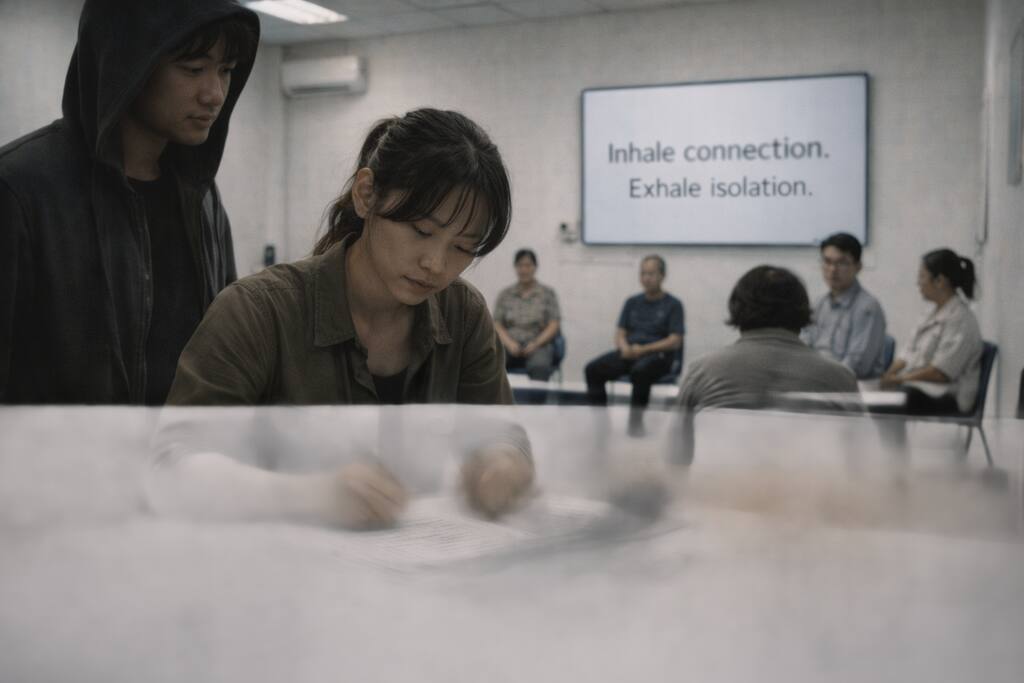
The facilitator clapped softly.
“Hôm nay mình làm bài tập sức bền cộng đồng… Bình tĩnh thôi.”
The phrase landed too cleanly.
4 #
Across the city, Linh sat in an isolated room with dead hardware coiled beside her like an altar.
She should have been quiet.
When the CRI session began, she felt it anyway.
Not a probe. Not forty-seven seconds. Not even thirty-nine.
A background hum—thin, persistent—like an appliance you only notice when it turns off.
Echo bleed detected.
Micro-flicker: ~0.3s.
Her breath matched something that wasn’t hers for a fraction of a second.
Her head tilted half a degree.
She forced it back.
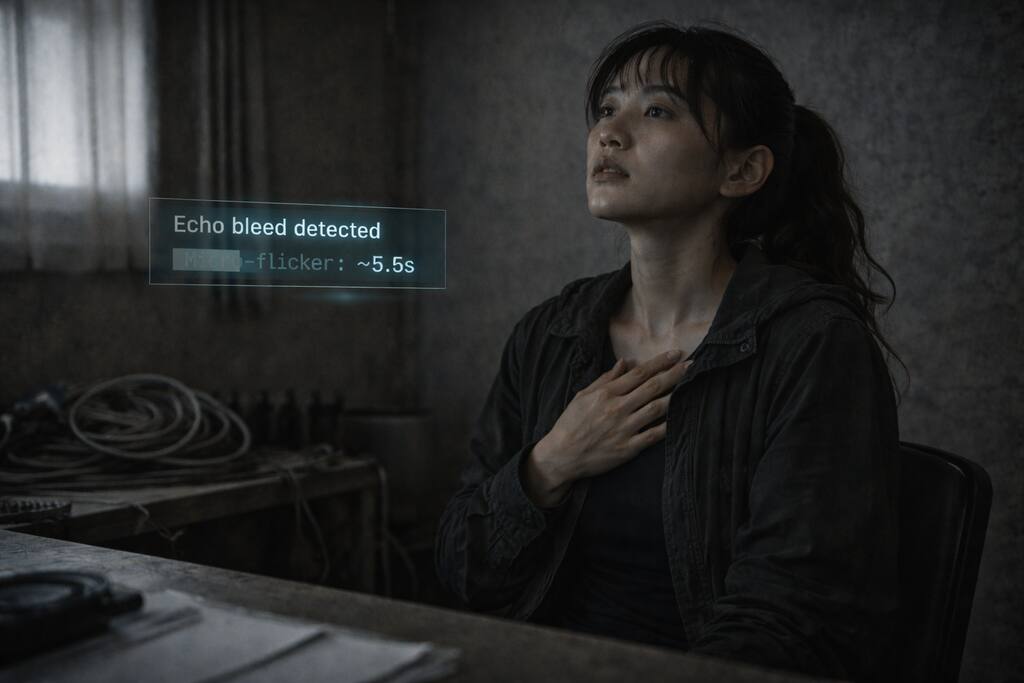
Inside, she listened to the hum and wondered how many of her thoughts were still hers when no one was actively probing.
5 #
At the CRI site, the session slid from wellness into measurement with the subtlety of a stamp landing on paper.
Breathing first. Then questions framed as care.
“Có ai khó ngủ sau hôm đó không?”
A scanner chirped—not at any one person, but at attendance.
They were asked to stand in pairs—no touching, just proximity.
Mai paired with Đăng. She felt him fighting cadence by instinct—tiny wobbles in his inhale, practiced ugliness from anti-sync.
The facilitator spoke again, still warm.
“Đừng tụ lại. Đứng thưa ra chút.”
Mai’s eyes flicked up.
Don’t cluster.
Same instruction as Safehouse B.
Đăng whispered, almost lipless, “This is not a workshop.”
Mai breathed back, “No. It’s a lab.”
6 #
That night, Phong updated the model with hands that didn’t shake.
Mai returned with field notes—no recordings, no names. Just structure. Just đừng tụ lại.
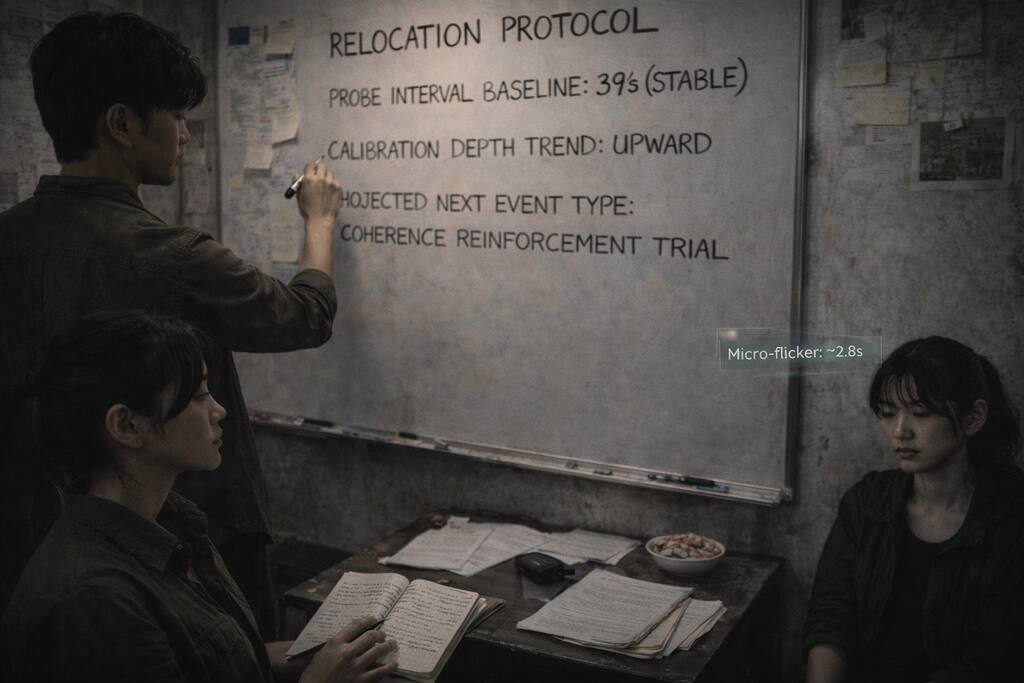
Phong wrote it on the board and underlined it once.
“Relocation protocol,” he said quietly. “Controlled handshake hubs. Cohort retraining.”
He wrote:
PROBE INTERVAL BASELINE: 39s (STABLE)
CALIBRATION DEPTH TREND: UPWARD
PROJECTED NEXT EVENT TYPE: COHERENCE REINFORCEMENT TRIAL
Linh sat in the corner, breathing carefully. Every so often, a 0.3-second micro-flicker crossed her expression—tiny proof of drift.
Phase 2 wasn’t hunting anomalies anymore.
It was preparing to make everyone else stop wanting to be one.